Trust at Transitions · Part 1 of 4
What Brings Clients Back Is Real, But What Keeps Them Isn't Built Yet
How wealth firms keep clients through the moments that test trust
A few weeks ago I read something that stuck with me.
Ari Galper, a global leader who has spent years studying trust-based selling, wrotea piece about why clients come back. Not why they leave. Why the ones who leave sometimes return.
His answer was simple, and I think it's exactly right. Clients don't come back for better performance or lower fees. They come back for the felt sense of being understood. The new advisor was competent. Professional. Available. But something was missing that had nothing to do with the portfolio.
The client who felt seen at the beginning of a relationship eventually felt managed. And the ones who left and came back were chasing the memory of that original attention.
I've been turning that over ever since. Not because I disagreed with any of it. Because it got me thinking further.
The math behind the feeling
This isn't just a nice observation about human nature. It's measurable.
According toMcKinsey, 32% of affluent and high net worth investors switch firms when their advisor leaves.Cerulli reports that advisor transitions typically cost firms between 11% and 22% of the assets in motion. On a $150 million book of business, handled poorly, that's $15 to $33 million walking out the door.
Galper is describing the feeling underneath those numbers. The client isn't leaving because the new advisor did anything wrong. They're leaving because something that used to be there stopped being there, and nobody can quite name what it was.
That's the part I keep sitting with. The industry has the data to prove trust erosion is real and expensive. What it doesn't have is a clear answer for why it happens so predictably, even to advisors who genuinely care.
The part that stayed with me
Galper's point is about the individual advisor. Stay curious. Keep showing up the way you did in that first meeting. Don't let real attention turn into efficient management.
That's true. I think he's right.
But it left me with a different question. One that isn't really about any single advisor.
If that early attention is what builds trust, why does it fade so often, even with advisors who genuinely care? Something else is going on.
What I think is actually going on
Here's the pattern I keep seeing in firm after firm.
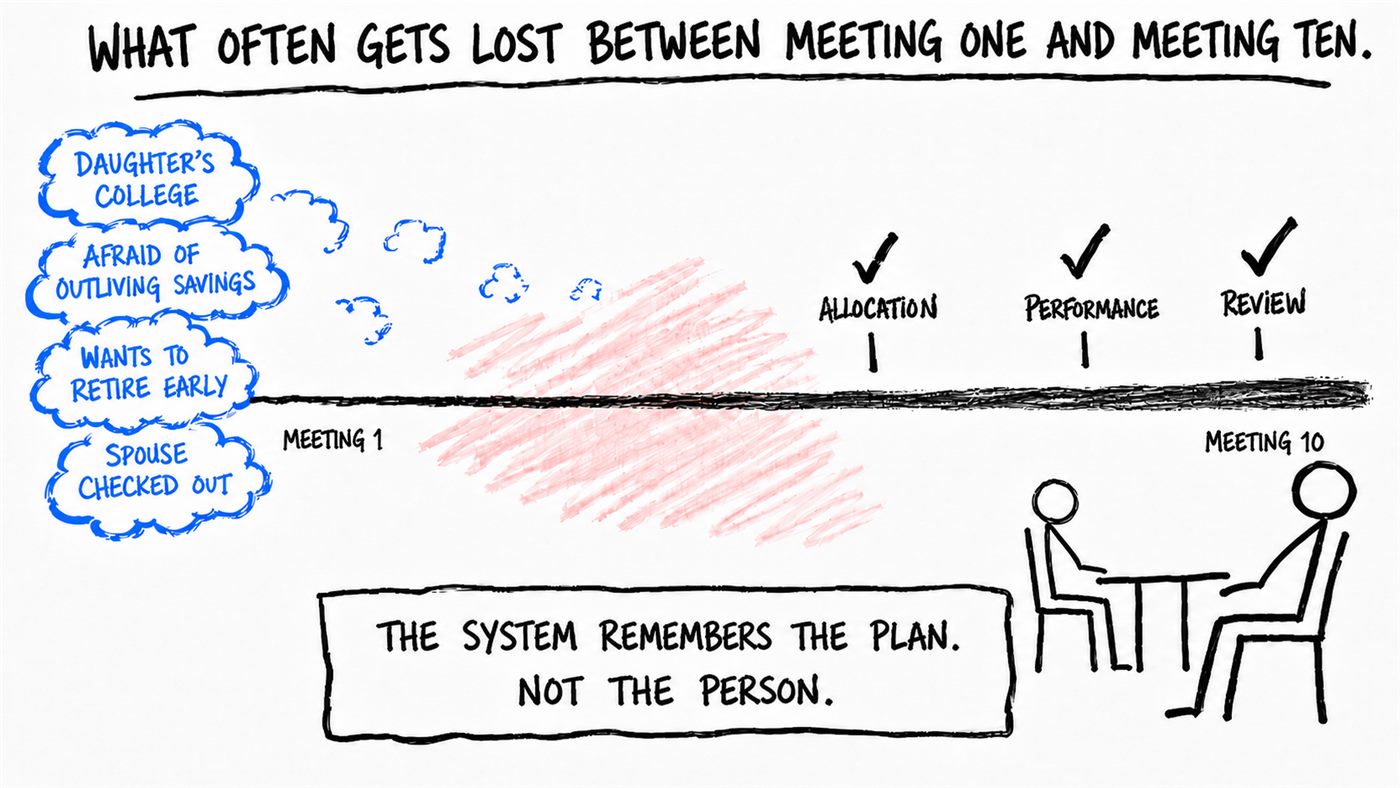
Onboarding is the high water mark of almost every advisor relationship. It's the one moment the entire process is oriented toward the person rather than the plan. Discovery questions. Family history. What the client is afraid of. What they actually want their money to do for them.
The client feels seen because, at that stage, the system is built to see them.
Then the rhythm changes. Annual reviews take over. The agenda shifts to allocation, performance, and planning updates. All the things that mattered in those early conversations, the daughter's college plans, the spouse who seemed checked out, the comment about wanting to retire two years early, don't get carried forward anywhere. They live in scattered notes, a fading memory, and whatever the advisor can reconstruct in the ten minutes before the meeting.
Nobody decided to stop caring. The infrastructure of advice was never built to carry the person forward. It was built to carry the plan forward.
That's not a character problem. It's a structural one. And structural problems don't get solved by advisors trying harder. They get solved by building something that didn't exist before.
Why this matters more this decade than it ever has
Wealth management is entering a decade of enormous movement, on three fronts at once:
- McKinsey projects the industry could be short 100,000 advisors by 2034
- The retirement wave that was theoretical five years ago is now daily reality inside most firms
- M&A consolidation is accelerating, and teaming models are expanding books faster than relational context can travel with them
Every one of those forces multiplies the exact moment Galper described. A client who felt deeply known by one advisor gets handed to someone new, and the firm assumes the transition was smooth because the accounts moved and the paperwork cleared.
The client isn't evaluating the paperwork. They're evaluating whether they still feel known.
That's not a soft concern for firm leaders. It's the retention math sitting underneath every growth strategy. The firms that figure out how to carry that felt sense of understanding forward, across meetings, across advisor changes, across growth, are the ones that keep clients for twenty years instead of losing a third of them the moment the person they trusted walks out the door.
The feeling has an answer. The infrastructure doesn't.
Galper named the feeling. Nobody has built the thing that keeps it from fading.
And it's not only when the advisor changes. The same gap opens whenever a client's life changes, a divorce, a business sale, a retirement, the moments they most need to feel understood. Those are the moments this whole series is really about.
Over the next few weeks I want to go deeper into three specific places where I see this gap show up most clearly:
- Why the first ninety days of a relationship set a bar that almost nothing after it is built to meet
- Why the system tracks what was said in a meeting but almost never what it meant
- What it actually looks like when a firm builds the system to hold onto trust, and grow because of it
That's the work I want to do here.