About Advisor Innovation Lab

The money side of advice has thirty years of software behind it. The person side still mostly runs on what one advisor happens to remember.

The financial half runs on software. Planning engines, projections, portfolio tools, tax optimization. Thirty years of engineering, and it shows.

The other half, where an advisor actually understands the person in front of them, still runs on one thing: what that advisor happens to remember. That is the part we're working on.

Four things are hitting wealth management at once. Each one alone would strain the old model.

110,000advisors expected to retire this decade

The people who hold the relationships are leaving.

Roughly 110,000 advisors, about 38% of the workforce and 42% of industry assets, are expected to retire this decade. That gets described as a staffing shortage. It's really a continuity problem: in most firms the deepest knowledge about a client lives in one person's head, and when they go, the firm keeps the accounts and loses the understanding.

McKinsey, cited in Russell Investments' 2026 Value of an Advisor study. Cerulli puts asset loss at roughly 22% when an advisor retires, 18% when one changes firms, and 11% on reassignment.

349RIA deals in 2025, up 26%

And the firms themselves keep changing hands.

The same thing happens when firms combine. Every acquisition, every tuck-in, every reassignment hands a household to an advisor who has the file but not the person. Firms buy the relationships, then have to earn them again, one meeting at a time.

RIA deal activity hit 349 transactions in 2025, up 26% over the year before, and 41% of RIA firms have now pursued inorganic growth (Schwab).

81%of inheritors plan to switch firms

Clients expect to be known, and the next generation most of all.

Clients want advice that connects to their actual life: the retirement that's really about identity, the inheritance that's really about family, the business sale that's really about letting go. When relationships end, performance is rarely the reason. And the people inheriting the money have no relationship with the firm that served their parents. That trust has to be built years before the money moves, not on the day it does.

Investors cite breach of trust (61%) and poor communication (60%) above poor performance (54%) as reasons to end an advisory relationship (CapIntel). A study of 2,500+ client reviews found 89% of what clients praise has nothing to do with investment performance (Wealthtender). Capgemini's 2025 World Wealth Report found 81% of inheritors plan to switch firms within one to two years of inheriting.

Judgmentwhere advisor value is moving

AI is resetting what makes an advisor valuable.

The technical work is getting fast and cheap to produce. That doesn't make advisors less valuable. It moves their value to judgment, timing, and whether a client feels genuinely known. Advisors can see it coming. Asked what would matter most for serving the next generation, they put a full picture of the client, and insight they can act on, ahead of automating meeting summaries and emails.

Capgemini, 2025 World Wealth Report. Russell Investments' 2026 study puts it plainly: "The differentiator is no longer access to information, but the ability to apply it with judgment, context and discipline."

Put them together. Relationships are changing hands faster than ever, from both directions at once. Clients expect more. And what used to make an advisor valuable is getting cheap to produce. The firms that come through this well won't be the ones with the best returns or the fastest AI. They'll be the ones whose clients still feel known.

Firms aren't short of information about their clients. They're drowning in it.

Meeting notes, planning documents, CRM records, emails, years of history. The problem was never that the information is missing. It's that nothing turns it into understanding.

Today the only thing that reliably closes that gap is an advisor who has seen it all before. The one who can tell when a practical question is carrying a worry underneath it, or when a retirement conversation is really about identity. That instinct is real. It also lives inside particular people, spread unevenly across a firm, and, as force one says, retiring.

Wealth management doesn't have a data problem. It has an interpretation problem. That's the sentence this company exists to answer.

We didn't build this because the market looked good.

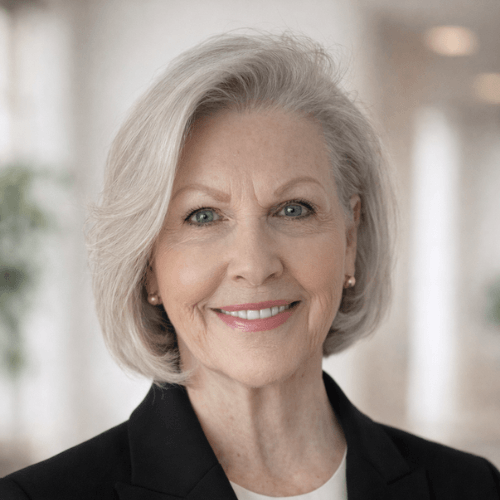
Kathleen Mundy and Yasmin Nguyen working together at a desk
Kathleen Mundy and Yasmin Nguyen · Niagara-on-the-Lake
Kathleen Mundy

Kathleen Mundy

Co-founder and COO

Kathleen retired at seventy, after turning a modest investment into a multi-million-dollar business. She was as prepared for the financial side of retirement as anyone could be. What she didn't expect were the quieter questions: who am I now, what is this time actually for, why is the house so silent. She looked for help and found an industry built to manage her portfolio and almost nothing built to guide her through the rest of it.

She had also seen the gap from the client's chair. Three advisors over the years. The first lost much of her money and told her so in a five-minute annual review. The second churned her account and never gave a straight answer. The third finally got it right. He knew her, and he asked about her life. Then he retired, and the advisors who replaced him never learned who she was. That last time, the money wasn't the problem. Being unknown was.

Yasmin Nguyen

Yasmin Nguyen

Co-founder and CEO

Yasmin spent two decades running businesses until he burned out completely. He walked away from his desk and spent eighteen months driving across America, trying to figure out what actually makes a life feel worth living. He came back having found joy again in small things, and wrote what he learned as The Game of Joy. Kathleen read it, reconnected with him, and endorsed it.

Then he watched his own parents move through retirement: secure by every measure that shows up on a statement, and quietly coming apart. His mother's health and memory were declining. His father had become her full-time caregiver and, in doing so, lost his sense of purpose, his confidence, and his circle of people. The planning had covered the money. Nothing had prepared them for the rest.

"The money wasn't the problem. Being unknown was."

Why we build for advisors instead of clients

Despite a twenty-year age difference, the two of us kept arriving at the same conclusion from opposite directions. Kathleen brought decades of entrepreneurial judgment and a first-hand map of what a life transition actually feels like. Yasmin brought the strategy and the technical ability to build something.

We set out to help people in transition directly. Then we saw a better way to do it: the professionals already sitting across from them. Help one advisor and you change hundreds of conversations.

That's why this company serves advisors rather than the families we first set out to help. Three years of advisor interviews, conferences, and work with real firms turned the idea into what exists now.

What we believe.

Purpose before products

A retirement. A diagnosis. A divorce. The loss of a spouse. These are some of the hardest stretches a person goes through, and they're also where a good advisor changes what happens next. We're not trying to make meetings more efficient. We're trying to help people come out the other side with more than their money intact. Everything else here follows from that.

Technology should amplify empathy, not replace it. Our job is to make a human better at a human thing. If a client ever feels they're talking to our system instead of their advisor, we've failed.

Information isn't understanding. A perfect transcript of every meeting a client ever had still won't tell you who they are. Capture was never the hard part. Reading what it means is.

Scale shouldn't cost warmth. We're not trying to turn relationships into records. The point is for a firm to feel more personal as it grows, not less. That's the opposite of what usually happens.

Say the unproven part out loud. We name what we haven't tested yet, in our materials and in the room. It costs us some deals. It's the only way this stays trustworthy.

And one we hold most carefully: the inner life of a client is not a data asset. It's something a person shared with someone they trusted. We treat it that way, and we've built the system so it can't become anything else.

How we treat client understanding →

Why it's called a Lab.

Because most of this work is research, and only some of it is software.

Depth is the advantage we're betting on. Features ship in a quarter. Understanding how a person moves through the hardest year of their life takes years, which is why it's worth doing.

Before any of it became a product, it was three years of studying how people actually move through advisor changes, retirements, divorces, business sales, and the loss of a spouse. Reading the practitioners and the research. Interviewing advisors who have sat through hundreds of these conversations. Testing what the system produces against people who know what good preparation looks like, and rebuilding when it fell short.

That work still runs. It's also public: Advising Humans, the show we host together, is 28 episodes of working the problem out loud. Mostly the two of us, with playbook series on the transitions that test a relationship hardest. One episode with a 33-year advisor, about what clients need during a handoff, became a tool advisors use today. The content and the product aren't two efforts. They're the same one, pointed at the same problem from two directions.

Advising Humans, and the writing behind the Lab →

Advising Humans cover art

Advising Humans. Two playbook series so far, on advisor change and divorce, plus the episodes where the two of us think out loud. Listen and subscribe →

Where this actually stands.

Built and working

The system produces real briefs today, across five of the hardest transitions a client faces, with more in development.

Tested, not assumed

Fourteen advisors and eleven clients reviewed real output. Advisors rated it 4.64 out of 5 overall, on real output. Clients rated 4.91 on whether they'd stay with, or choose, a firm that prepared this way. Not one of the fourteen said generic AI could already do this, which was the reaction we'd been bracing for.

Already paid for

Two wealth management firms pay us today for the assessment and behavioral tools we built for their advisors. This company has been funded by that work and our own money, not outside investment.

Not yet proven

No advisor has yet used these briefs before their own client meetings, week after week, as a habit. That's the one thing still missing, and it's exactly what our preview firms are helping us close. We'd rather tell you that than let you find it.

If any of this sounds like your firm, we'd like to talk.

We're working directly with a small group of firm leaders while this is early. If that's you, the door is open. If you're just interested in where this goes, follow along instead. Both are useful to us.

Where we're trying to get to, eventually. Advice where the technology makes people more human with each other, not less. And where a hard year in someone's life is something a firm guides them through well, instead of a risk it manages around. That's the longer work. The brief is where it starts.

Advisor Innovation Lab · Niagara-on-the-Lake, Ontario · working with firms across Canada and the United States