Trust at Transitions · Part 3 of 4
Advisors Remember Their Clients, But Nothing Connects What They Know
How wealth firms keep clients through the moments that test trust
The first two parts of this series traced a single problem. Part 1 made the case that the felt sense of being understood, the thing that actually keeps clients, was never going to survive on advisor effort alone, because nothing was ever built to carry it forward. Part 2 found where it starts to slip: in the earliest days of a relationship, when a firm pays close attention during onboarding and then slowly stops.
This part goes somewhere harder to see. Not what gets asked in the first ninety days, but what happens to everything an advisor picks up after that.
Two advisors can look at the exact same client file and see two completely different things.
One sees a transaction history. Contributions, distributions, rebalances, the paper trail of a financial life.
The other remembers that the client mentioned, almost in passing, a tense situation with a business partner. That conversation happened five months ago. It changed how the advisor read every question that client asked after that. It is not in the file. It only lives in the advisor's memory.
That gap, between what the system records and what the advisor actually knows, is where trust quietly starts to decay.
What actually gets written down
This isn't a rare oversight. For years, it's been closer to the industry norm. The Financial Planning Association'sTrends in Client Communication study found that although 80% of advisors use a CRM, only 41% actually add notes to it after a meeting, and just 33% keep written notes in client files at all.
That's starting to change. AI notetakers like Jump and Zocks now transcribe meetings automatically, which solves the capture problem more completely than a decade of CRM adoption pushes ever did.
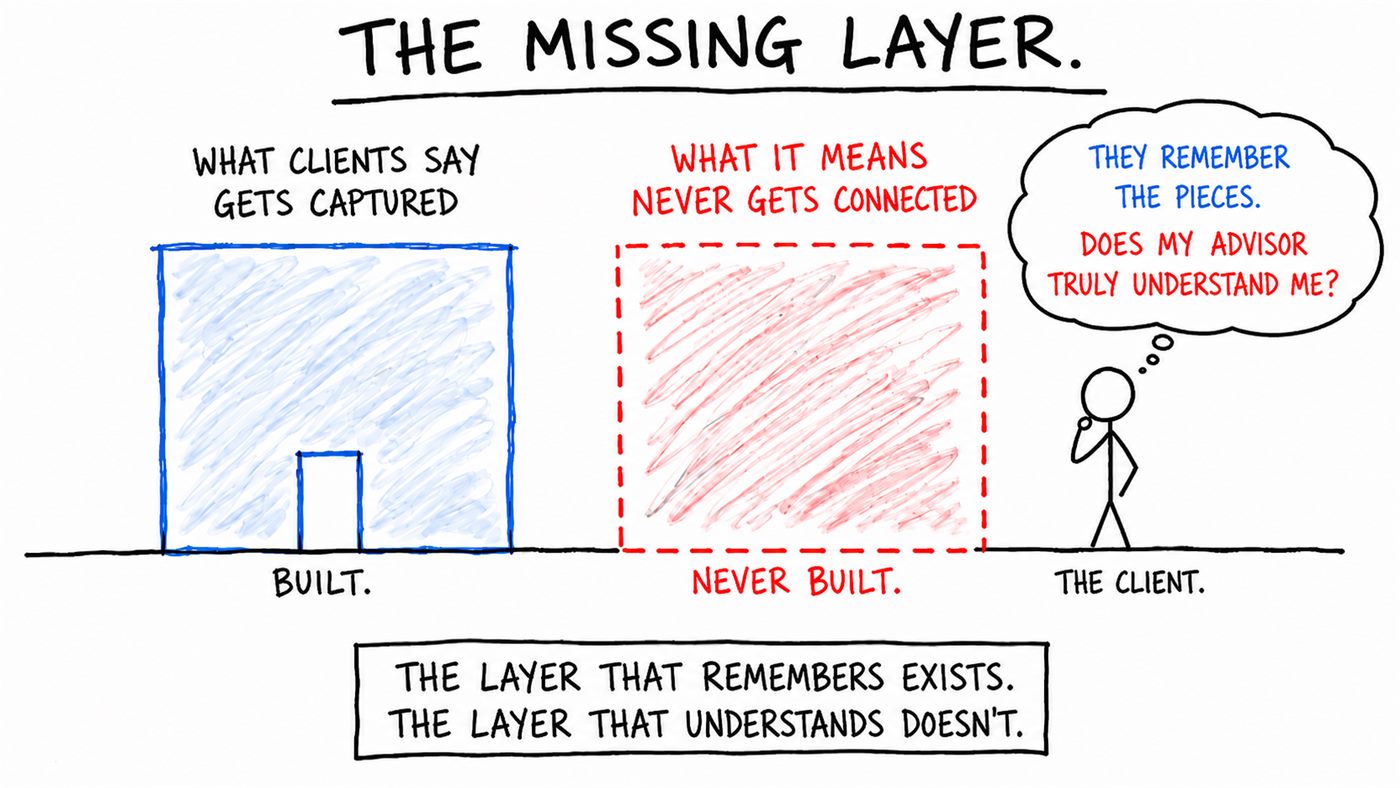
But a transcript is a record of what was said. It's not a record of what it meant, or what an advisor should do with it three meetings from now. Solving capture doesn't solve interpretation. That's a different problem, and it's the one this article is actually about.
Saved isn't the same as understood
A CRM tracks contributions made, meetings held, documents signed. Even a perfect transcript tracks what was said, word for word.
Neither tracks what any of it meant.
The business partner comment. The mention of a health scare that came up once and never again. The remark about wanting to retire early specifically to help care for an aging parent. Those aren't transactions, and now they aren't even missing from the recording. They just don't have anywhere to go.
So it gets mentioned, acknowledged with real care in the moment, and then buried the second the advisor moves to the next task. Not because the advisor didn't care. Because nothing in the system, not the CRM, not even the smartest transcript, was built to hold onto what it meant.
There's a second layer to this that matters just as much. Even if every signal got saved perfectly, on its own, one comment about a business partner or one mention of a health scare doesn't tell you much. The real insight sits in the connections between signals that nobody has time to make. The health scare mentioned in March. The comment about wanting more time with family in June. The question about long-term care insurance in September. Looked at individually, those are three unrelated notes. Looked at together, they're a client quietly reconsidering their entire retirement timeline.
Nobody is doing that connecting. It takes noticing a pattern across meetings, months apart, something no single conversation makes obvious on its own.
That connection work isn't about handing an advisor a conclusion. It's about handing them a better question, something to bring back to the client and explore together. Done well, it doesn't replace the advisor's judgment. It gives the advisor a reason to ask exactly the right question at exactly the right meeting, which is often what makes a client feel deeply understood in the first place.
The next meeting starts from the plan. Not from the person.
What's in an advisor's head works, until it has to move
For a single advisor with forty clients, this might not show up as a crisis. Memory can paper over a lot of gaps at that scale.
It stops being invisible the moment a book of business changes hands. A retiring advisor's replacement gets full account access and a performance history. They do not get the fact that the client was burned by a previous advisor years ago and needs extra reassurance before trusting any new recommendation, or that the client's real fear isn't market volatility, it's outliving their own savings.
Firms are handling more of these transitions than at any point in the industry's history, driven by retirements, M&A, and teaming models that reassign accounts as books grow. Every one of those transitions runs into the same wall. The plan transfers. The context that made the relationship feel personal does not, because it was never written down anywhere a successor could find it.
That's not a training issue. It's an infrastructure issue.
Remembering isn't the same as connecting
No advisor sets out to make a client feel like a stranger. Most of them remember far more than they get credit for.
But memory isn't a system, and memory doesn't transfer when an advisor leaves the room, retires, or gets pulled onto a bigger book. And even when something does get captured, a transcript, a note, a CRM entry, it usually sits alone. Nobody's connecting it to the comment from three meetings ago that would turn it from a passing remark into a real pattern.
That's the piece that's been missing from every conversation about advisor transitions, client retention, and evenAri Galper's own writing on why clients come back, the felt sense of being understood, not just served well. The problem was never really about whether advisors care enough to remember. It's about whether anything besides one person's memory is doing the remembering, and doing the connecting.
All three pieces point the same way. The problem was never that advisors care too little. It's that nothing but memory is doing the remembering, and nothing at all is doing the connecting. So the last question is the one that matters most: what it actually takes to build the thing that holds all of this together, so a client stays understood through every moment that matters, and what that's worth to a firm that gets it right. That's what Part 4 is about.