Trust at Transitions · Part 2 of 4
Onboarding Isn't the Problem, But What Happens After It Is
How wealth firms keep clients through the moments that test trust
Ask any advisor about their oldest client relationship and you'll get a story, not a fact sheet. The year the client lost their father. The year their daughter started college. The exact chair they sat in the first time they walked into the office.
Ask the same advisor what was covered in that client's last two reviews, and the story disappears. What's left is a summary. Allocation changes. Performance numbers. A plan that got updated.
That gap between the two answers isn't a memory problem. It's the shape of almost every advisor relationship.
What ninety days is actually worth
Bain & Company's research on customer retention found that increasing retention by just 5% can increase profits by 25% to 95%.
That swing is bigger in wealth management than in most industries, because the thing being retained isn't a subscription or a purchase habit. It's a client's belief that someone understands their whole financial life. Lose that in the first ninety days, and there's no coupon or feature update that wins it back. The relationship either survives on the strength of that early read, or it doesn't.
The first ninety days aren't a warm-up period before the real relationship starts. They're the relationship, at its highest point of attention, setting the terms for everything that follows.
The only meeting built around who the client is
Onboarding is the one part of the relationship built around the client instead of the plan.
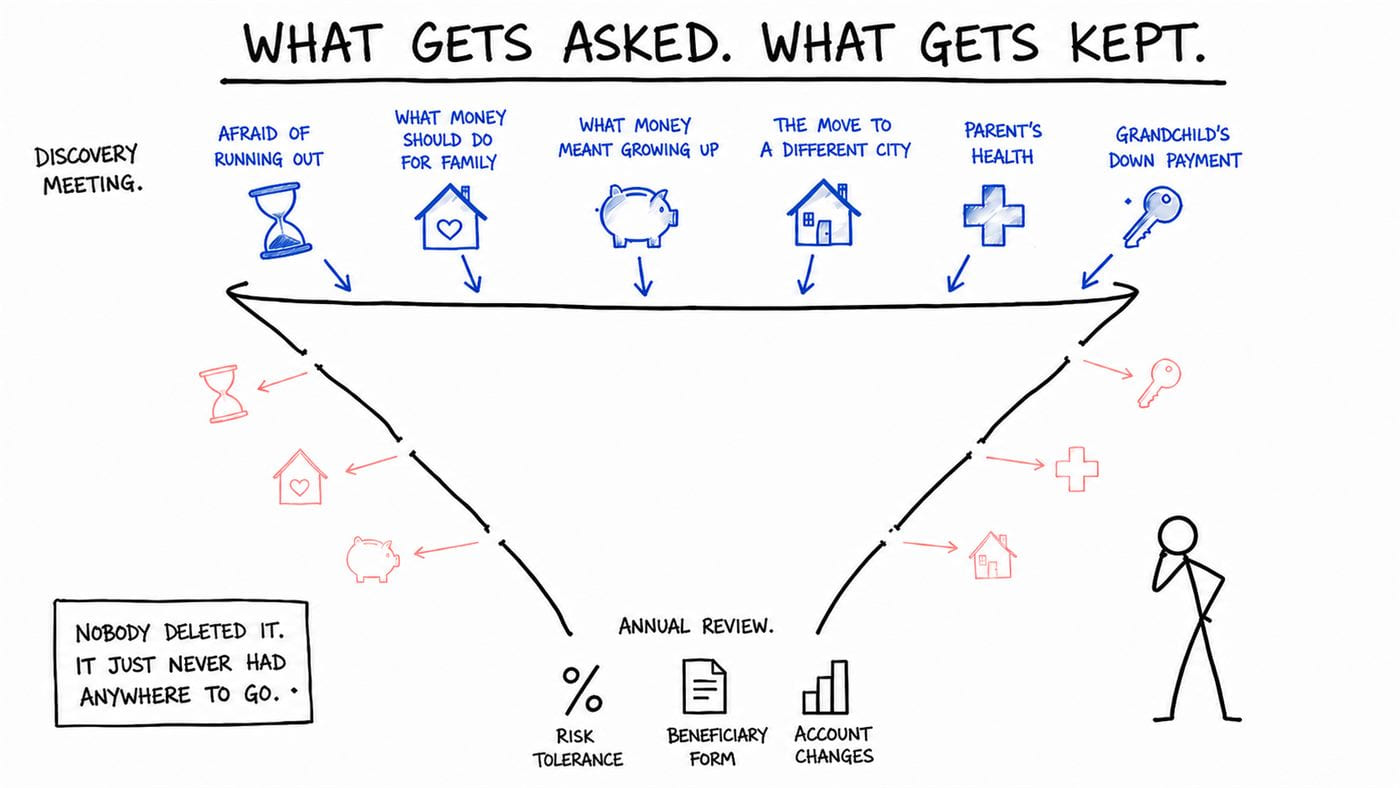
Discovery meetings ask what a technical intake form never would. What are you afraid of. What did money mean in your house growing up. What do you actually want this money to do for your family, not just for your portfolio.
The client leaves that meeting feeling like someone finally asked the real questions.
Then the calendar moves to annual reviews, and the questions change:
- What changed in your accounts this year
- What's your updated risk tolerance
- Any changes to your beneficiaries
Those are the right questions for a portfolio. They are not the same questions that built the relationship in the first place.
The move to a different city that came up once. The worry about a parent's health that never got mentioned again. The plan to help a grandchild with a down payment three years out. None of that shows up on a review agenda, so none of it gets revisited, updated, or built on. It sits wherever it landed in month one and gets older every year.
The metric that doesn't exist
Most firms measure onboarding by whether it got done. Documents signed. Accounts funded. Discovery meeting completed and logged.
Almost no firm measures whether the client still feels understood eighteen months later, or three years later, or the year their advisor retires and someone else picks up the file.
Firms have built careful systems to track whether onboarding happened. Very few have built any system to track whether the thing onboarding created is still alive.
Teaming can make this worse, not better. A junior advisor or a new team member can inherit full account access on day one and inherit almost none of what that discovery meeting surfaced. The plan transfers cleanly. The person behind the plan doesn't.
The expiration date nobody wrote down
The high water mark isn't the problem. Discovery meetings are genuinely good. Advisors ask real questions and mean it.
The problem is what happens the day after. There's no structure carrying that context into the next meeting, or the one after that, or the one three advisors from now. The system was built to capture the plan. It was never built to keep the person inside the plan visible.
Ari Galper has written aboutWhy Clients Come Back . Not for better performance. For the felt sense of being understood. That's the specific mechanism behind it. Clients don't stop feeling known because advisors stop caring. They stop feeling known because the one moment built for knowing them has an expiration date nobody wrote down.
Next, I want to go inside the part of this that's even harder to see. Not what gets asked in the first ninety days, but what happens to everything an advisor learns after that, the comment in passing, the signal in a follow-up call, the thing a client mentioned once and never brought up again. Where does that go, and why does it disappear even when the advisor never forgot it.