Trust at Transitions · Part 4 of 4
Trust Was Always the Point, But Nothing Was Built to Hold It
How wealth firms keep clients through the moments that test trust
A client going through a divorce doesn't want to explain her whole situation twice. Neither does the founder selling the business he spent thirty years building, or the retiree trying to figure out who he is without a job title attached to his name.
Every one of them deserves to feel like the person across from them already understands what they're walking through, not because they explained it perfectly, but because someone was paying attention.
This is the fourth and final piece in a series about why that feeling is so hard to sustain. If you haven't readArticle 1,Article 2, andArticle 3 yet, I'd start there. This one builds directly on all three.
You're already behind if you're not moving here
Capgemini's2026 World Wealth Report found that firms supporting their advisors with intelligence-driven technology platforms, ones that deliver timely client insight and coordinate it across a firm, see measurably stronger client satisfaction, share of wallet, and retention than firms that don't.
That gap doesn't sit still. Every quarter a firm waits is another quarter competitors pull further ahead on the exact things clients notice most, whether they feel understood, and whether they stay.
Industry analysts have started calling this shift the move toward a"unified client brain", a single place where the signals that used to live in scattered notes, individual memory, and disconnected systems finally connect into one picture of who a client actually is, and what they're going through.
That's not a category we invented. It's a direction the industry is already turning toward, because the firms living this series' diagnosis are the ones feeling the most pressure to solve it.
The trust risk of making a client start the relationship over
You already know what happens when a client has to explain something they've explained before. They don't say anything. But something shifts. They realize they're starting over with someone who was supposed to already know them, and that's the moment the trust starts to go.
By now, three articles in, you also know why it happens, and that it has nothing to do with how much an advisor cares.
So picture the opposite. An advisor walks into a conversation about a divorce, a business sale, or a retirement already knowing what matters to this specific person. Nothing got lost between the last meeting and this one. The client doesn't have to start over, because the advisor never did.
We had to do something about it
This series started with something I read fromAri Galper. He wrote that clients come back not for better performance, but for the felt sense of being understood, and that the relationships that last are the ones where that feeling never fades.
I agreed with him completely. I still do. But it left me with a question his article didn't answer, and I've spent three articles chasing it.
The first one made the case that the feeling Galper described was never going to survive on advisor effort alone, because it depended on something nobody had actually built.The second went looking for where that breaks down first, and found it in the earliest days of a relationship, when a firm pays the most attention to a client and then slowly stops.The third went further in, into the day-to-day workflow, and showed that even when a client says something that matters, almost nothing connects it to anything an advisor can use down the road.
Each article ended in the same place. This isn't about advisors caring less. It's about them working inside a system that was never built to hold onto what matters.
And that gap doesn't stay quiet. It gets loudest at exactly the moments a client needs to feel understood most, the divorce, the business sale, the retirement, the year everything changes. Those are the moments trust is genuinely won or lost.
Naming that wasn't enough. We had to build something that actually held onto it.
Here's what that looks like
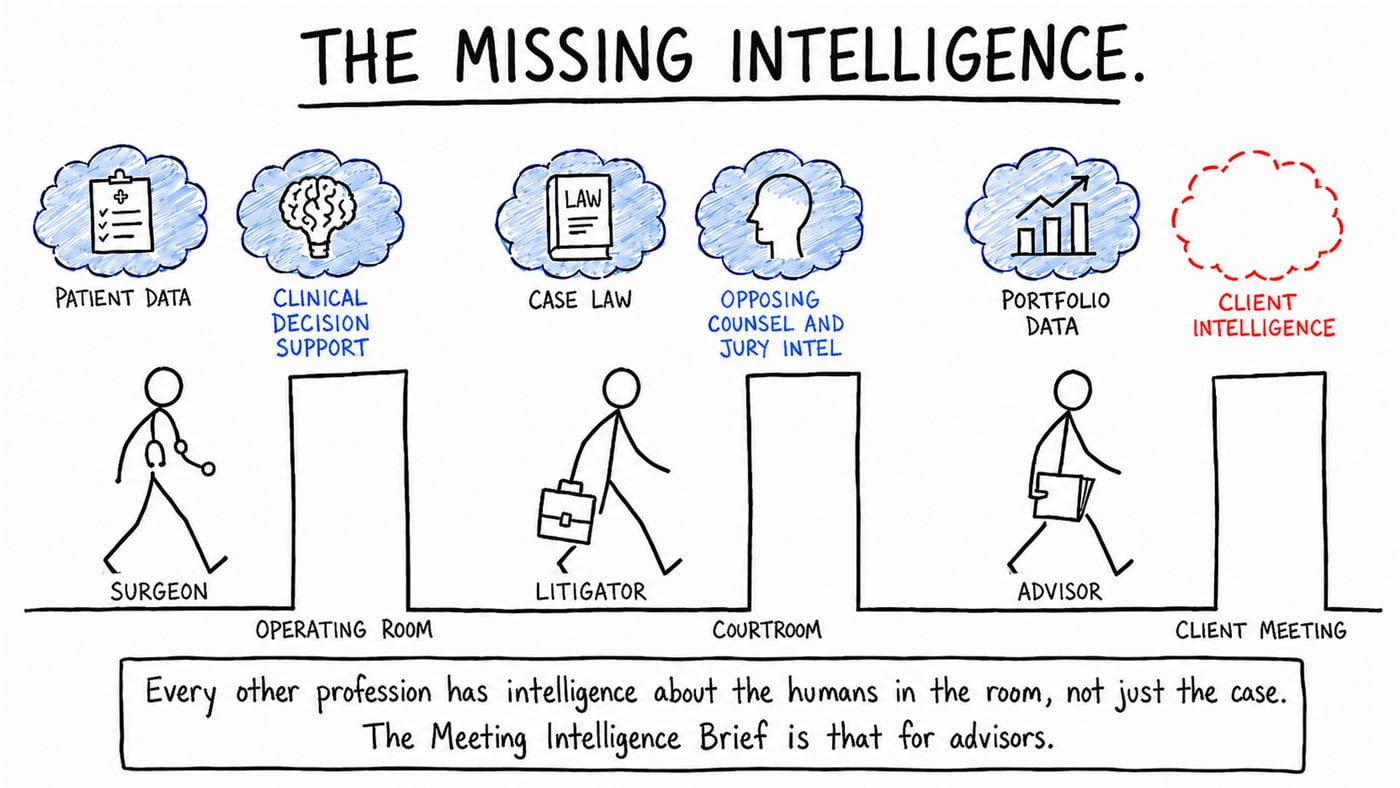
Here's what we built. It's a platform that does one thing for an advisor: before a meeting, it hands them a Meeting Intelligence Brief.
Think of the senior partner every firm has one of, the one who's sat through decades of these conversations. Every kind of divorce, every kind of business sale, every kind of retirement and loss and career change. They know what to look for, what to listen for, and what to ask. They connect a comment from months ago to the thing the client just said. They know how to guide someone through the hardest moment of their financial life because they've done it a hundred times. Most firms have one person like that, if they're lucky. Nobody can clone them.
The Brief is the closest thing to putting that person in the room before every meeting. It tells the advisor what this client is likely going through right now, what to watch for, what to ask, and what not to say, drawn from that depth of experience across more than a dozen of the hardest transitions an advisor ever faces. And it pulls from everything that client has shared before, so the advisor isn't starting from a blank page or a half-remembered note.
None of this replaces an advisor's judgment. Every advisor I respect got into this work because they're good at reading people, not because they wanted to become data analysts. The Brief exists so that skill has something real to work with, instead of leaving the hardest conversations to memory and whatever happened to get written down.
The business risk of not having the Meeting Intelligence Brief yet
Every one of these moments is a client quietly deciding whether to stay, based on nothing more than whether the person across from them actually understands what they're going through. Some of those clients leave. The ones who stay start looking anyway, and firms rarely find out until the assets are already gone.
But retention is only half of it. These same moments are where growth actually happens. A client who feels deeply understood through a divorce or a business sale is the client who consolidates held-away assets, introduces you to their attorney and their friends, and trusts you with their spouse and their adult children when the next generation inherits. Growth in a wealth firm doesn't only come from marketing or acquisitions. It comes from the quality of the conversation in the room, at the moments that matter most.
That's the part worth sitting with. This isn't another initiative competing for advisor attention. It strengthens the priorities a firm already cares about, retention, organic growth, referrals, next-gen relationships, succession, and makes every one of them perform better, because all of them run through the same client conversations.
The firms that get access to this first won't just protect the relationships they have. They'll grow through the transitions, on both sides of the relationship, that competitors can only hope to survive.
We're opening the Meeting Intelligence Brief to a small group of firm leaders for an invite-only preview. Direct access, direct feedback, before it goes any further.