The Rise of Human Wealth Tech · Part 4 of 4
What Advisors Carry in Their Heads, a Firm Can Now Read
How the industry is finally building around the person, not just the portfolio
The One Part We Left Unsolved
This series has made one argument three times, from three angles.
The human side of advice was always real, but it lived in the advisor, not in the firm's systems. When an advisor leaves, the plan transfers and the understanding doesn't, and the industry pays for that in lost clients every year.
And the reason it keeps happening is that firms have never had a way to carry a client's understanding beyond the advisor who built it. For a long time they didn't need one. The advisor stayed, the book was smaller, and clients accepted a certain amount of starting over. That's no longer the world. Advisors move and retire faster, books are bigger, and the next generation of clients expects to be known without having to re-explain themselves every time something changes. The old way of carrying understanding, in one person's memory, can't keep up with any of it.
So the question we've been circling is this. If that understanding is this valuable, can it live anywhere other than one person's memory? That's the problem we've spent the last two years working on. Here's where we've gotten.
What We're Building
We call it Meeting Intelligence.
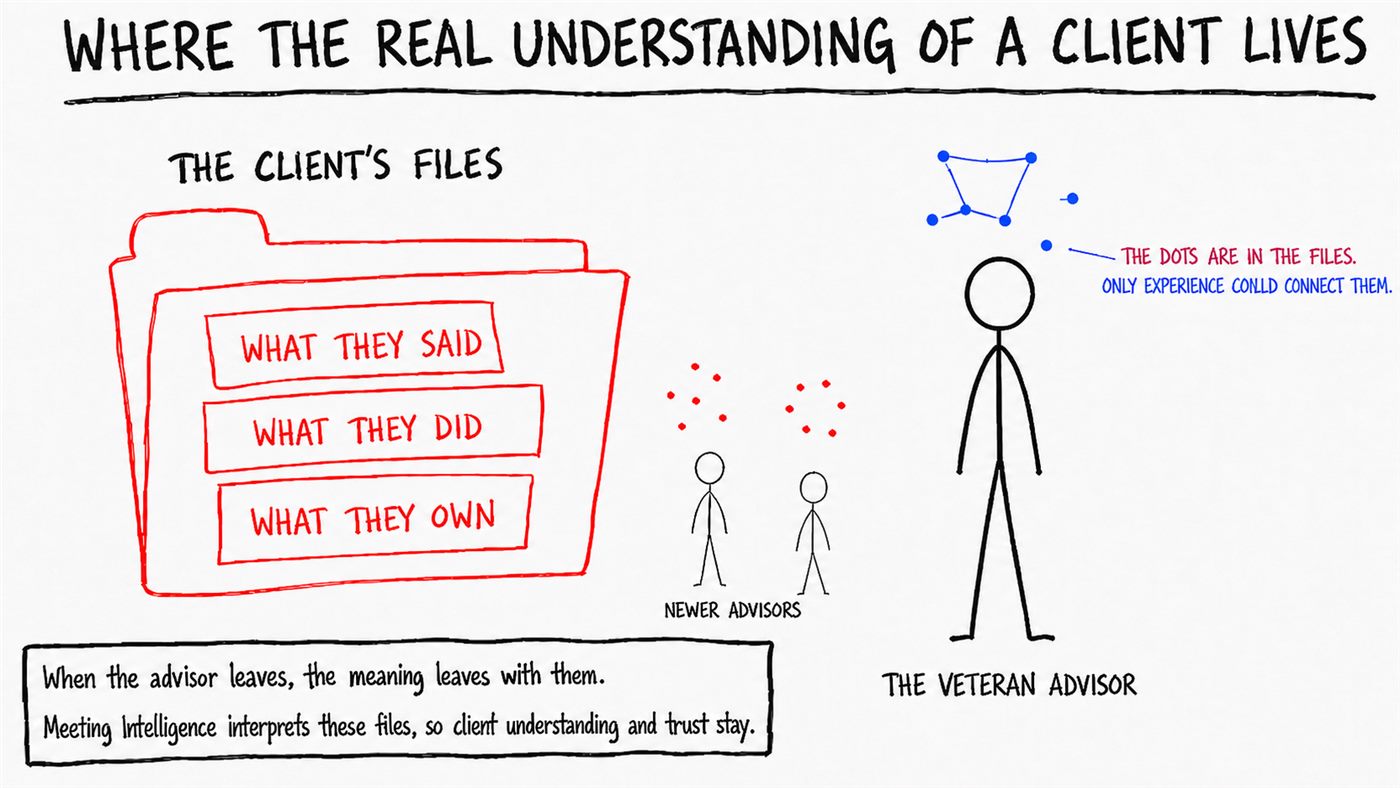
Start with what an experienced advisor actually does. Give a thirty-year veteran a client's history and they'll see things a newer advisor would miss:
- That this year's worry connects to an offhand comment the client made two years ago.
- That the client goes quiet on the same subject every time it comes up.
They can read it because they've read thousands of clients before. That pattern recognition is what decades of experience buys you.
So the understanding was there in the client's history all along, just hidden. What it took to see it was experience. That gap is always there. It only becomes obvious when a client moves to a newer advisor who has the same history in front of them but not the same years of reading it.
Meeting Intelligence reads a client's history and surfaces what an experienced advisor would want to catch, including the things anyone can miss when they're busy, or when they're facing something they've never seen before. Then it puts that understanding back into the CRM and systems the firm already uses, so it shows up in the advisor's normal workflow, when they onboard a client, prep for a review, or follow up after a meeting. Not just at a transition. Every time they sit down with that client.
That's the difference from a notetaker. A notetaker writes down what was said in a meeting. Meeting Intelligence reads across everything that was ever said, draws out what an experienced advisor would notice, and leaves it in the firm's own systems instead of one advisor's memory.
When Everything Happens at Once
Here's where it matters most.
Take a client who is retiring. A seasoned advisor has guided a hundred retirements and knows the pattern cold. But this client isn't only retiring. They're going through a divorce at the same time, and they've just had a health diagnosis that changes everything. Each of those alone is hard. Together, they collide. The divorce changes what retirement means. The diagnosis changes the timeline on both.
Almost no advisor's experience prepares them to hold all three at once, for one specific person, in the same meeting. That understanding isn't in any single part of the client's history. It's in how the parts connect. And connecting them, across years of conversations, under time pressure, before a meeting, is exactly the kind of reading that used to require either decades of experience or more hours than anyone has.
Meeting Intelligence reads across the whole history and connects what the client is actually navigating, so the advisor walks in seeing how it fits together, instead of three separate things they have to piece together on their own. This is the part of advice this whole series has been about, made usable in the one place it counts, the meeting.
Why We Started With the Meeting
Of all the places understanding could be surfaced, the meeting is where it's richest and where it's most often lost.
It's richest because the real understanding comes out in conversation, not in forms. A client will never fill out a questionnaire that says "I say I'm fine when I'm not." But they show it, meeting after meeting, to anyone reading closely enough. And it's most often lost because there's never been a good way to hold what a meeting reveals. The advisor remembers some of it, writes down less, and the rest is gone by the next morning.
Start there, and you're working on the part of the relationship that matters most and survives the least. That's why the first thing we built lives around the meeting.
We're honest about where this is. It's built and it's real, and we're now inviting a small number of firms to help shape it before it's widely available. This is early, on purpose. The problem is too important to solve carelessly.
What This Makes Possible
Step back, and the point isn't a better meeting prep tool. It's what becomes possible when understanding stops living in one person and starts belonging to the firm.
An advisor transition stops being a cliff. The new advisor doesn't have to rebuild years of understanding from scratch or hope it gets passed along. The client's own history is already read and connected into something they can use from the first meeting. A growing firm can keep the feeling of being known even as it adds clients and advisors, instead of watching service get thinner as it scales. And the thing clients actually stay for, the sense that someone here truly gets them, stops depending entirely on one person staying forever.
That's the shift this series has been tracing. The financial side of advice runs on software. The human side has been waiting for a way to run on more than one person's memory. This is our attempt at building it.
If you lead a firm and this problem is familiar, the lost households, the transitions that never fully land, the understanding that walks out the door when an advisor does, I'd like to talk. Send me a message. We're having early conversations with a small number of firms, and the right ones may become pilots.
And if you work with firms rather than inside one, as a consultant, a platform, a coach, and you're seeing this same problem from your side, I'd like to hear from you too.
Part 4 of The Rise of Human Wealth Tech. Part 1 named the shift. Part 2 looked at what it costs when a client's understanding can't move with them. Part 3 asked what it would take to keep it. This one is our answer.