The Rise of Human Wealth Tech · Part 2 of 4
The Plan Transfers. The Understanding Doesn't.
How the industry is finally building around the person, not just the portfolio
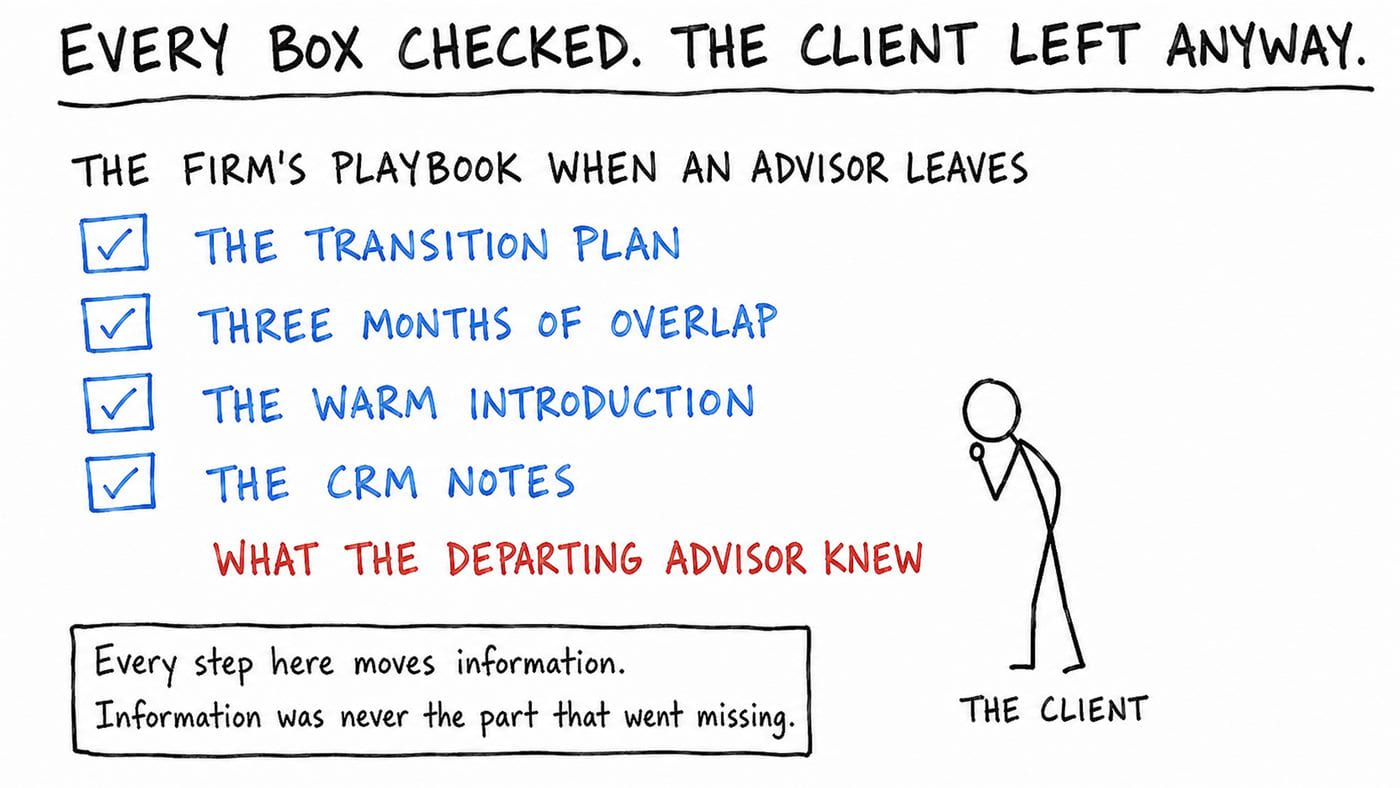
When a Household Changes Hands
A senior advisor retires after thirty years. The firm does everything right. There's a transition plan, a warm introduction, a co-branded letter, three months of overlap. The receiving advisor is sharp and genuinely cares. On paper, nothing was dropped.
Then, eight months later, one of the best households quietly moves half its assets to another firm. No mistake was made. The client just stopped feeling like the new advisor got them, and one day a friend mentioned someone they should talk to, and that was that.
This is the part of an advisor transition that firm leaders feel in their numbers and struggle to explain. The accounts moved fine. The plans moved fine. Something else didn't move at all, and it turned out to be the thing holding the relationship together.
The Part That Was Never in the File
So what actually left when the advisor did? It's tempting to just say "the relationship," but that's too vague to be useful. The real answer is more specific.
What the retiring advisor had wasn't in the file. It was thirty years of small things learned:
- This client will say yes in the meeting, then call back three days later once their spouse has weighed in, so a good advisor stops pushing for an answer on the spot.
- Another client says "I'm fine" precisely when they aren't.
- A third one's real fear isn't running out of money, it's being a burden to their kids, and every recommendation has to speak to that fear even when the client never says it out loud.
None of that is written down anywhere, because there was never a reason to write it down. It lived entirely in the advisor's head, and it worked beautifully right up until the day that advisor left. Then the client sat across from someone new who had the plan, had the balances, had the notes, and still had to relearn, one meeting at a time, everything the last advisor already knew.
To the client, it feels like starting over with someone who doesn't know them yet. In a relationship that used to feel easy, that's the moment they start to wonder if they should be somewhere else.
Why the Transition Playbook Misses the Point
Firms know transitions are risky, so most have a standard playbook for it: a transition plan, a few months of overlap between the outgoing and incoming advisor, a warm introduction, a CRM full of notes. Each one helps. But they're all built to move information, and information isn't the part that goes missing.
Take the overlap period. Two advisors working side by side for three months transfer the easy things: the account details, the upcoming decisions, the personalities. What they can't transfer in three months is the pattern that took years to learn, because most of it the first advisor couldn't fully explain even to themselves. Ask a great advisor what they know about a client and they'll tell you a few things. The rest only surfaces the moment it's needed, and by then the person who had it is gone.
Or take the CRM. Every firm has one, and the notes are supposed to be the memory. But a note captures what was said, not what it meant. "Client anxious about market" is a record of a moment. It doesn't carry the years of context that let an advisor know this client's anxiety is a passing weather system that clears by Thursday, while another client's anxiety means they're about to do something drastic. The note transfers. Knowing how to read it doesn't.
Even the warm introduction only goes so far. "I trust her, so you can too" buys the new advisor time. It doesn't tell them who the client actually is. It hands over the benefit of the doubt and hopes the new advisor can earn real understanding on their own before the goodwill runs out.
Each of these does something real. None of them reaches what actually left, because they all move information to the new advisor, and knowing a client isn't the same as having information about them. That kind of knowing was never anywhere the firm could reach.
The Part Firms Have Priced In Without Naming
This isn't only a soft problem. It's a financial one, and the numbers are already known. Over the next decade, the advisors expected to retire hold about 42% of all industry assets, according to McKinsey. That's not a distant demographic worry. It's nearly half the money in the industry changing hands.
And when it changes hands, a lot of it leaves. McKinsey found that 32% of investors switch firms when their advisor retires or moves on. Almost one in three. Most firms treat that as a cost of doing business, planned for and budgeted around.
But sit with what that number actually is. It's the price of a relationship that couldn't be handed over. Every client who leaves is a household that decided, quietly, that being known by their advisor mattered more than the plan, the returns, or the fees, and that they weren't willing to start over building that with a stranger.
Firms have accepted that cost for so long that it looks inevitable. It isn't. It's the direct result of the one part of advice that still lives only in the advisor's head. Which raises a question the industry is finally in a position to ask. If knowing a client this well is this valuable, and this expensive to lose, why is it still the only part of the relationship that leaves when the advisor does?
Part 2 of The Rise of Human Wealth Tech. Part 1 named the shift. This one looked at what it costs when the understanding of a client can't move with them. Next: what it would take to keep that understanding from leaving with the advisor.