The Rise of Human Wealth Tech · Part 1 of 4
The Financial Side Runs on Software. The Human Side Runs on the Advisor.
How the industry is finally building around the person, not just the portfolio
The Client Who Felt Known, Until Suddenly They Didn't
Every advisor has had this client. The one who, three years in, stopped explaining themselves. You knew what the college fund was really about. You knew which market drops made them call and which ones they'd ride out. You knew the son they worried about and the number that would actually let them sleep. None of it was in the file. It was in your head, built up slowly, meeting after meeting, until the relationship ran on understanding instead of just paperwork.
Now picture that client getting reassigned. You retire, or you move firms, or the household passes to the next generation and a younger advisor inherits the account. The plan transfers cleanly. The balances transfer. The understanding, the thing that actually made that person feel known, walks out the door. The new advisor inherits the accounts but not the understanding, and the client feels the difference immediately, even if they can't name it.
The same thing happens when the client's life changes instead of the advisor's. A divorce, a business sale, losing a spouse. That's exactly when a client needs their advisor to already understand them, and exactly when that understanding is hardest to hand over.
That gap has always existed in wealth management. What's new is that the industry has finally started building technology aimed straight at it.
Advice Had Two Halves. The Tools Only Built One.
Nobody in wealth management needed to be told the human side matters. Advisors have always known that trust, timing, and truly understanding a client are what the whole relationship runs on. The books have said it for decades. The training programs, the coaching, the "it's a relationship business" truisms, all of it has been around a long time.
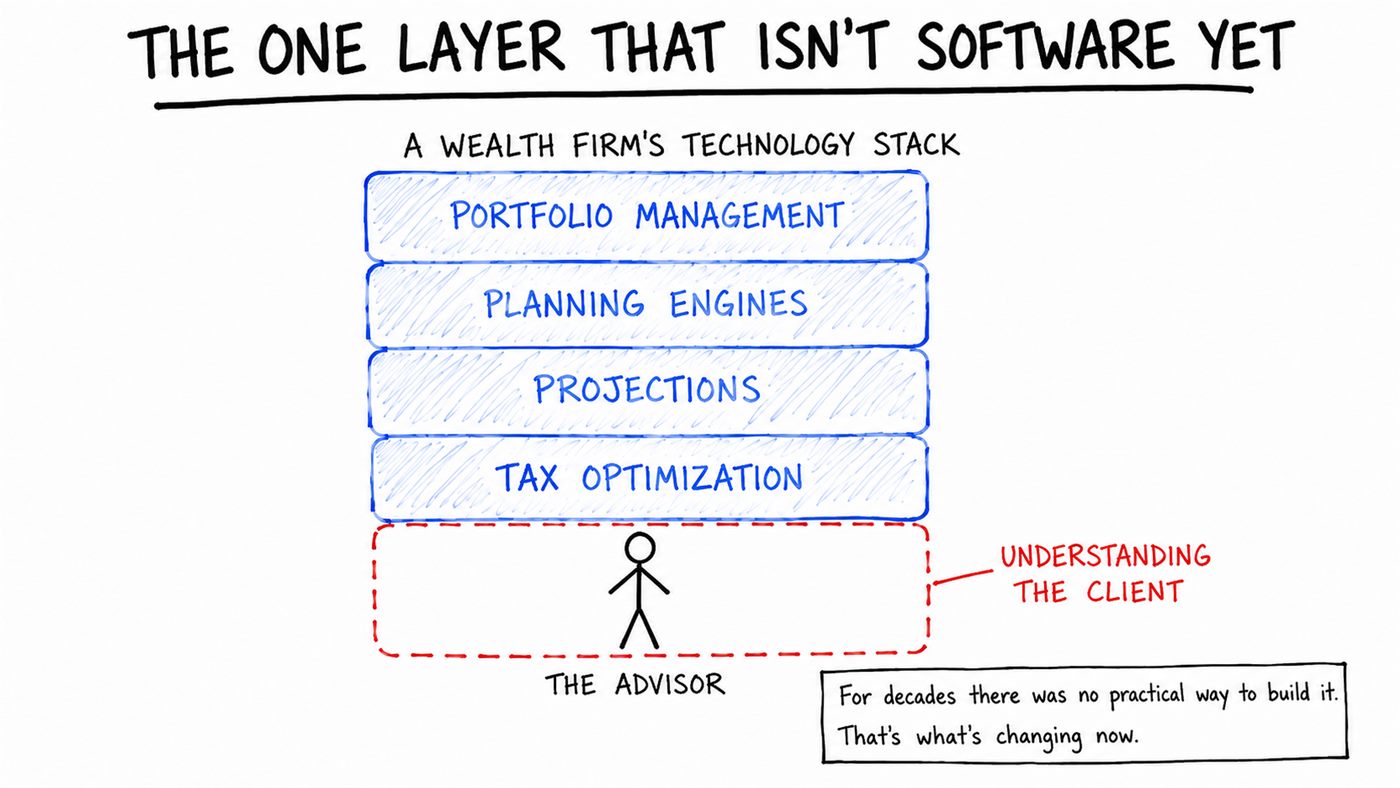
But the human side always lived somewhere apart from the technology. The financial half got engineered. It became software, projections, planning engines, the whole machinery a modern firm runs on. The human half stayed a soft art. Something you learned slowly, carried as a talent, or picked up in a workshop. It mattered enormously and it lived almost entirely in the advisor, because there was never a practical way to build it into anything.
That's what's changing. Recently, Conquest Planning and Shaping Wealth put both halves on the same screen. Conquest's engine handles the analytical work, what a client should do. Shaping Wealth's Lydia handles the other half, helping an advisor work through the emotional, high-stakes conversation where that recommendation lands or doesn't. They united them on purpose, because they saw the human side could finally be built into the workflow instead of left to instinct.
It isn't happening alone. Jump, the most widely adopted of these tools, raised eighty million dollars and said plainly that saving advisors time was only the first phase. Its next phase is reading the behavior and sentiment inside client conversations.RFG took a stake in AI notetaker Zocks and spent two years building the data layer to make client conversations usable across the firm. Different firms, different starting points, all working the same problem: taking the human side of advice, the part that always resisted being built, and starting to build it.
That shift deserves a name. Call it Human Wealth Tech, technology built not around the portfolio, but around the person the portfolio belongs to.
Three Parts of Advice, and the One That Gets Lost
Look closely at a good advice relationship and there are three distinct things happening.
There's the recommendation. What should this client do. Wealth tech has spent thirty years getting extraordinarily good at this.
There's the delivery. How does the advisor communicate that recommendation so the client trusts it and acts. This is newer work, and it's where much of the current energy is going. The Conquest and Lydia integration is, at its core, these first two parts finally sharing a screen. Lydia even reaches into the third part, coaching an advisor using a client's prior interactions, which is more than most tools attempt.
Then there's that third part itself, and it behaves differently than the other two. It's the understanding of the specific person. What they're navigating, what they've told you over years, why they are not interchangeable with anyone who happens to share their financial profile.
And here's the distinction that matters. Pulling up what's known about a client in the moment is one thing, and the better tools are starting to do it. Holding an understanding that builds and compounds over years, that stands on its own rather than living inside one advisor's memory, is a different and harder thing. A recommendation can be calculated. A conversation can be coached. Even a client's history can be surfaced on demand. But an understanding that persists, that survives the advisor who built it, has to exist in a form the whole firm can reach, not just the advisor who has it. That's the part that still mostly lives in an advisor's head.
Which is exactly why it's the part most exposed the moment a client has to move from one advisor to another. The recommendation and the delivery are coming together fast, and tools are getting better at reaching for a client's history in the moment. What's still hard is making that understanding last beyond the one advisor who has it, so the thing that made a client feel known doesn't walk out the door when the advisor does. That's the part I'd watch most closely.