The Rise of Human Wealth Tech · Part 3 of 4
Capturing What a Client Says Isn't the Same as Knowing Them
How the industry is finally building around the person, not just the portfolio
The Fix Most Firms Reach For First
The first two parts of this series named a problem. The understanding that makes a client relationship work lives in the advisor, not the firm. And when the advisor leaves, that understanding often walks out with them, which is why firms lose a share of clients at every transition.
This part is about what to do with that. And the natural first answer, the one most firms reach for, turns out to be the one that keeps coming up short.
The obvious fix is to write it all down. Better notes. More detailed records. A discipline of capturing everything after every meeting, so nothing lives only in one person's head. Firms have been trying some version of this for years, and the AI notetakers arriving now make it easier than it's ever been. Record the meeting, transcribe it, file it. Problem solved, right?
Except it doesn't quite work, and it's worth being precise about why. Writing it down does something real. It just doesn't reach the thing that actually matters, and seeing why points directly at what a real solution would have to do.
Why a Perfect Transcript Still Isn't Enough
A transcript is a record of words. Understanding is what those words mean, and the two are not the same.
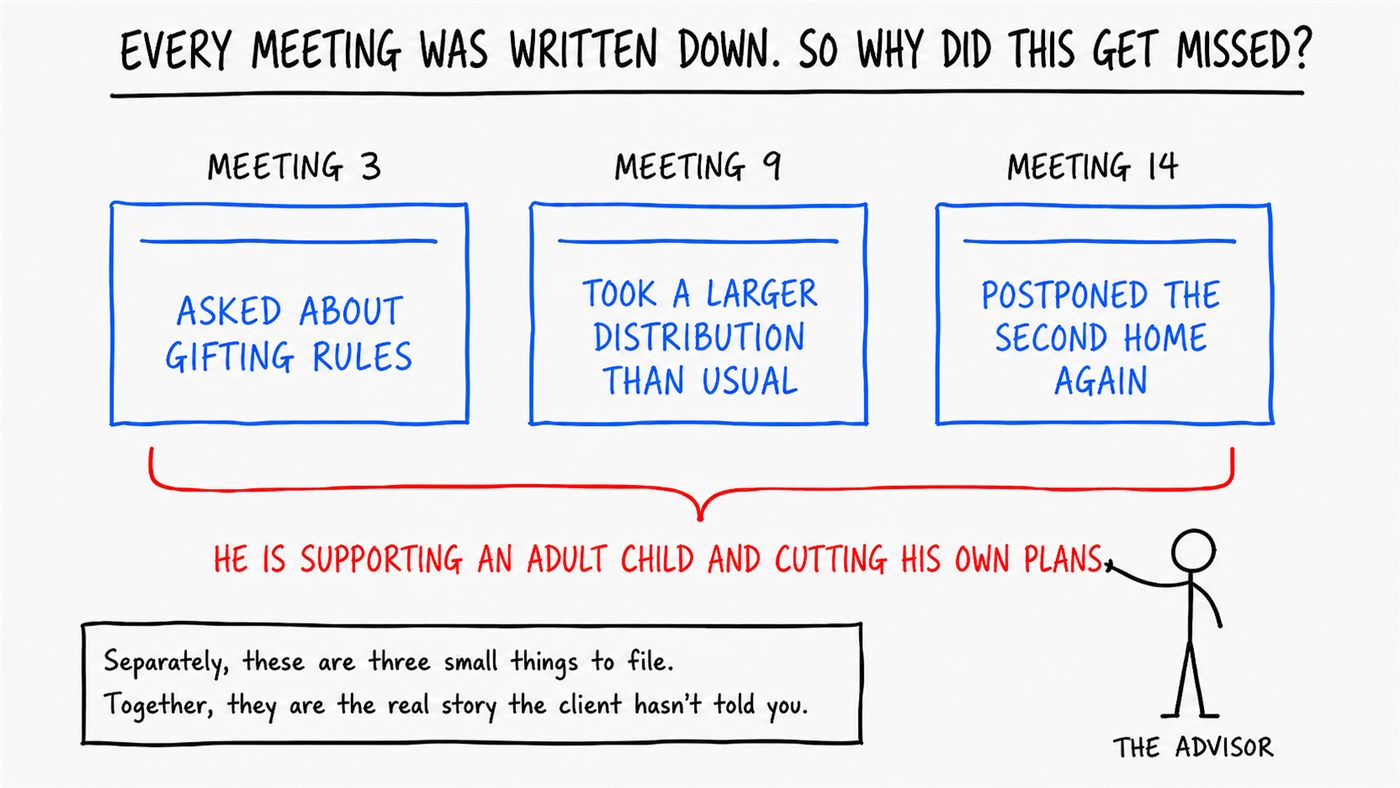
Take a full, perfect transcript of every meeting a client ever had. Hand it to a new advisor. They have everything that was said and still don't know the person, because the meaning was never in the words alone. It was in how the parts connect. The worry a client first raises as a passing joke, then brings up again as a question a few months later, and only names outright when they're finally ready to act on it. A transcript captures each moment and misses the thread that runs between them.
That thread is what matters, and it was never written down, because no one writes down a pattern they haven't noticed yet. An experienced advisor noticed it live, over years, without trying. Ask them to record it and they couldn't, because most of it they know without knowing they know it.
And most relationships aren't decades deep anyway. Plenty of meetings are the third one, or the very first. The principle holds either way. When a client has years of history, there's a lot for an advisor to draw on. When a client is brand new, there's no history yet, so the understanding has to be built from the start, by asking the right questions and knowing which answers actually matter. Done well, the first conversation already starts surfacing who this person is and what they're navigating, instead of leaving the advisor to piece it together meeting by meeting.
Whether a client is thirty years in or brand new, the goal is the same. No advisor should have to sit down knowing the numbers but not the person.
So the first thing a real solution has to do is harder than capture. It has to read across whatever exists and connect it, and find the thread an advisor would only catch with years of attention.
The Test a Real Answer Has to Pass
Say you could do that. Say something could read a client's whole history and surface the pattern an experienced advisor would see. Even then, there's a second problem that's harder than the first, and it's where most tools fall short.
It has to be usable in the moment it's needed, by a busy person, without extra work.
An advisor has fifteen minutes between meetings. They are not going to read a forty-page playbook, sit through a training course, or click into another dashboard. If knowing the client well takes more time than the advisor has, it doesn't get used. And when the advisor walks in without a real read on the person across from them, the client feels it, and trust starts to slip. So it's not enough to figure out what matters about the client. It has to reach the advisor at the right moment, in a form they can actually use, short enough to take in during the time they have.
And it has to be right there in the tools the advisor already uses. The moment it becomes a separate step, something extra to open or check, it gets skipped. It has to be part of the advisor's existing workflow, not another thing added on top.
None of these are optional. A real answer has to do all of them: read across everything and find the pattern an advisor would need years to see, then give it to them short, right before the conversation, inside the tools they already use. Get any one wrong and it goes unused.
Why This Is Only Now Possible
Here's the part that makes this a real moment, not just a nice idea.
Everything I just described was impossible until recently. Reading across years of scattered conversations and finding the human pattern in them is exactly the kind of thing software couldn't do a few years ago and is only now starting to. The raw material was always there, sitting in the firm's records. What was missing was any way to read it the way a person does.
That's what changed. Not the value of knowing a client, that was always obvious. What changed is that for the first time, the understanding buried in a firm's own history can actually be pulled out and put to use. So the question is no longer whether it can be done. It's who does it well, and what it looks like when someone does.
We think we have an answer. That's the last part of this series.
Part 3 of The Rise of Human Wealth Tech. Part 1 named the shift. Part 2 looked at what it costs when a client's understanding can't move with them. This part asked what it would take to keep it. Next: our answer.