A note · on advisor change
The Moment Trust Starts Drifting
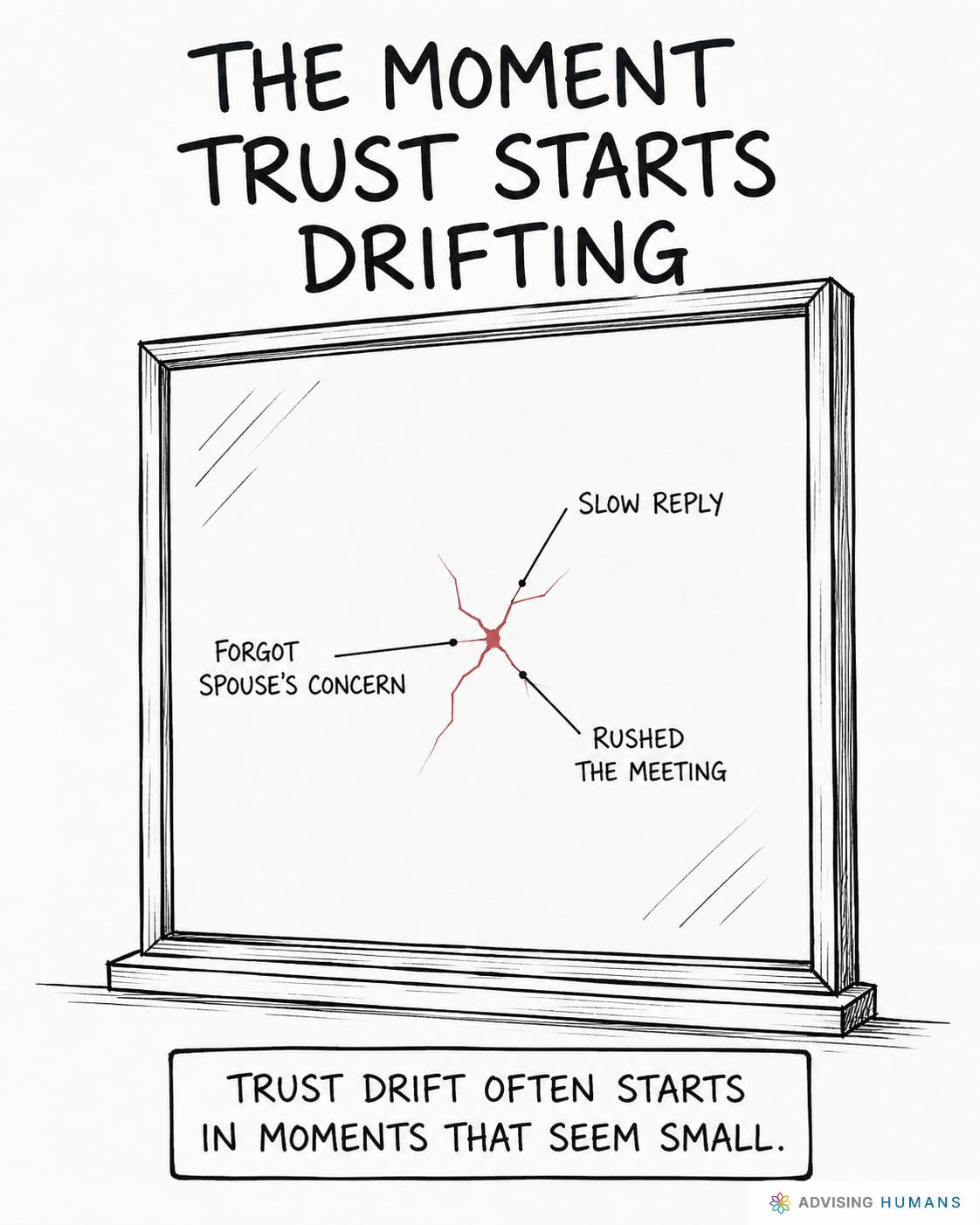
Have you ever noticed how client trust rarely breaks in one dramatic moment?
Most of the time, it starts much smaller.
A slow reply.
A spouse’s concern that gets missed.
A meeting that feels a little rushed.
A detail the client expected someone to remember, but no one did.
Individually, these moments can look minor.
No complaints.
No transfer request.
No obvious problem.
But during advisor change, small moments can carry more weight.
- A founder retires.
- A successor advisor steps in.
- A client moves to a new service team.
- A firm navigates an acquisition.
Inside the firm, the transition may look complete.
Accounts transferred.
Forms updated.
Meeting scheduled.
CRM notes moved over.
But from the client’s side, the relationship may still feel undecided.
They may be quietly asking:
- Do they really know me?
- Do they understand my spouse?
- Did my story come with me?
- Will the things that mattered before still matter now?
That is where trust drift begins.
Not always with anger.
Not always with a direct concern.
Not always with a dramatic exit.
Sometimes it starts when the client shares a little less.
- Replies a little slower.
- Stops bringing up the sensitive issue.
- Leaves the spouse out of the next meeting.
- Delays the follow-up.
- Starts wondering whether the relationship still feels personal.
And sometimes, the financial signal appears before the relational concern is ever named.
The client may keep existing accounts in place, but stop bringing new assets into the relationship.
They may withhold the next opportunity.
They may quietly move new assets elsewhere.
Not because the firm failed operationally.
Because the client no longer feels fully confident emotionally.
That is the risk.
Firms can measure the visible transition while missing the felt transition.
Operational continuity matters.
But clients also need relational continuity.
They need evidence that their history, preferences, family dynamics, communication style, and concerns have carried forward.
Because clients don’t just transfer assets.
- They transfer context.
- Confidence.
- History.
- Trust.
- And the feeling of being known.
The lesson:
Trust drift often starts in moments that seem small.
And those small moments are exactly where advisors can strengthen the relationship, if they notice them early.
A better transition question might be:
“What are the small moments that would help this still feel personal, steady, and well handled for you?”
For firms navigating advisor retirement, succession, team changes, client transitions, or acquisitions, this is one of the most important things to watch:
Not only whether clients stay.
But whether they still feel confident enough to deepen the relationship.
What small signals do you think firms should watch before trust starts drifting?