On the industry
The Missing Layer in the Wealth Management AI Conversation
Last year I was at the Advise AI conference and sat through a session on meeting prep tools. The demo was sharp. The time savings were real. When the presenter finished, I asked a question about trust: does the system actually know what's going on with this client?
Not their portfolio. Not their risk score. Not their last contact log.
What's going on with them.
The answer came back clean: absolutely, and that's exactly why capturing better data leads to better client relationships. The conversation moved on.
I watched the same thing happen at XYPN. At the McCombs wealth management conference. Every time the AI conversation started, it organized itself around the same questions: how much admin time does it save, how does it integrate with the CRM, how does it reduce friction in the workflow.
Good questions. Real problems. But every time I asked about trust, about whether the system understood what was actually happening in a client's life, the answer came back as a version of the same thing: better data capture leads to better relationships.
That assumption kept going unchallenged. Nobody seemed to think it needed to be.
The finding wealth management missed
What I kept noticing in those rooms finally has a name. Gartner presented it at theirData and Analytics Summit in London last month and the AI world took notice. The wealth management world mostly didn't.
Their finding: AI agents without context will hallucinate, and in wealth management, a hallucination isn't a technical error. It's a misread of a client's life.
Gartner predicts that organizations that prioritize context in how their AI understands data will see up to 80% better accuracy and up to 60% lower costs by 2027.
The context is different. The missing piece is the same.
When Gartner says "semantics," they mean structured meaning. The difference between a system that knows a client sold a vacation property and a system that understands that the property was tied to a marriage that ended last year.
Those are not the same thing. And if you're an advisor walking into that meeting, the difference between them is everything.
Technically accurate. Humanly wrong.
There is a difference between a system that knows what happened and a system that understands what it means.
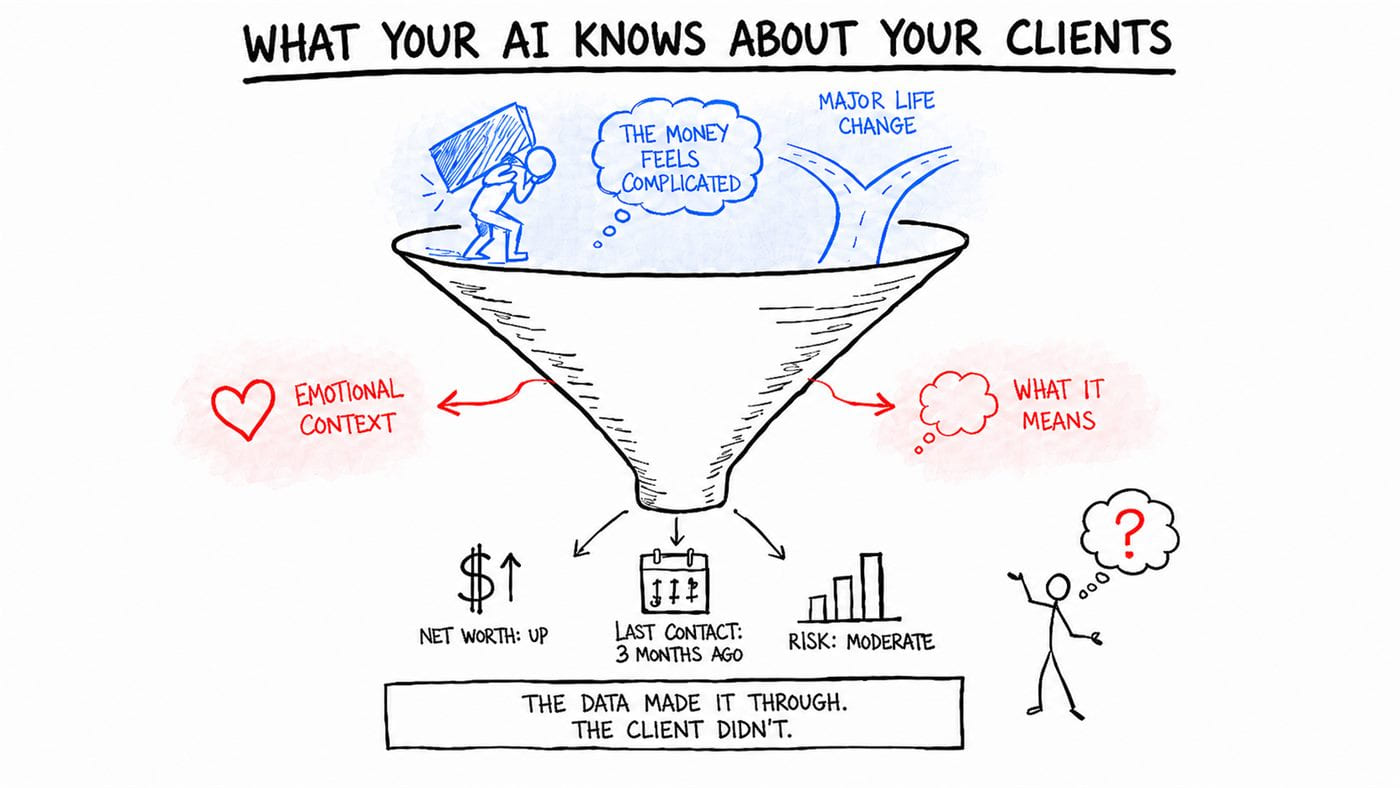
A system can tell an advisor that a client's net worth has increased, that they've always been cautious with money, and that their last interaction was three months ago. All of that can be true. None of it tells the advisor that the client is exhausted from a business exit they didn't fully want, that the money feels complicated to them right now, and that what they actually need this quarter is someone who slows down before talking about what to do with the money.
The data is correct. The read on the client is completely off.
Most AI tools in wealth management are built to process client data efficiently. Very few are built to understand what that data means when a real person is sitting across the table.
The data exists. The meaning doesn't.
Most client data in wealth management is captured at the transaction level. What happened. What was decided. What was scheduled.
Very little of it captures why. The emotional context. The life event that changed what a client actually needs from their advisor this year.
And even when that context exists, inside an advisor's head or buried in a call note, it rarely makes it into the system in a form the system can use. It sits as text, next to the account balance, indistinguishable from it.
That context doesn't disappear because advisors don't care about it. It disappears because nobody built the system to hold it.
The difference between storing client data and understanding what it means is not a software feature. It's an architectural choice about what the system is actually for.
The question firms are not asking
The firms I talk to are asking which AI tools to buy. They're asking how to reduce advisor administrative load. They're asking how to serve more clients without the relationship feeling like it's been handed to a system.
Those are the right operational questions.
And some are starting to ask how to attract next generation clients who will choose their advisor based on something beyond investment performance.
The harder question is underneath all of them: what does your AI actually know about what's happening in your clients' lives?
If the answer is "whatever is in the CRM," the follow-up question is whether that data tells you anything meaningful or just tells you what happened.
There's a difference between a system that knows a client has been with the firm for 22 years and a system that understands what that longevity means, and what it will take to protect it the next time the person serving them changes.
That distinction is not theoretical. It shows up in the meeting. Every time.
The AI conversation is the right one. It's just missing a question.
The firms that will use AI well over the next several years are not the ones with the best models. They're the ones that built the context layer underneath.
That's not a technology argument. It's a relationship argument.
Every client your firm has built a long relationship with got there because someone carried their story forward. Through market cycles. Through life changes. Through advisor transitions. The question worth asking is whether your AI knows your clients or just knows their data.
The clients your firm will keep, and the next generation of clients you want to attract, are looking for the same thing. They want to feel that someone is carrying their story forward, not just managing their accounts.
AI that only knows what happened can't do that.
AI that understands what it means can.
If you've been in a room where this question went unasked, someone else on your team probably has too.
The Advisor Innovation Lab develops meeting intelligence solutions that help wealth management firms move beyond client data to client understanding. Our technology is built for the moments when knowing what the data says is not enough.