On the human side of advice
The Judgment Age: Why Next-Gen Clients Still Need Human Advisors in an AI-Shaped World
The dashboard that started the thought
A friend sent me a dashboard recently that I couldn’t stop thinking about.
It was Andrej Karpathy’s US Job Market Visualizer. Karpathy is a leading AI researcher, a co-founder of OpenAI, and a former AI leader at Tesla.
The dashboard looks at hundreds of occupations and explores how exposed different jobs may be to AI. It is not trying to predict the future perfectly, but the lens is useful.
The more a job’s work product is digital, the more exposed it may be.
That includes work like:
- Writing
- Summarizing
- Analyzing
- Modeling
- Communicating
- Processing information
That made me think about wealth management.
Because much of the advisor workflow is becoming more digital.
AI can increasingly help with:
- Meeting summaries
- Planning notes
- Portfolio analysis
- Client emails
- Research
- Follow-up tasks
- Scenario modeling
- Educational content
- CRM updates
AI will keep moving into those parts of the work.
And in many cases, that is a good thing.
Advisors are buried in prep, follow-up, documentation, communication, research, and repetitive tasks. If AI can reduce that friction, it should.
But the dashboard left me with a bigger question:
If AI reshapes the digital work of advice, where does the advisor matter most?
What next-gen clients are really asking for
Around the same time, I had a podcast conversation with a guest about next-generation clients.
That conversation stayed with me too.
Because when firms talk about next-gen clients, the conversation often becomes about technology.
Better portals. Better apps. More video. More social media. More digital communication.
All of that matters.
But I don’t think that’s the whole story.
Next-gen clients are not simply asking for a more digital advisor.
They are asking for an advisory relationship that feels more collaborative, personal, and relevant to their life.
They have grown up with access to more information than any generation before them.
They can:
- Search
- Compare
- Watch
- Listen
- Ask AI
- Follow creators
- Join communities
- Form opinions before they ever sit down with an advisor
They are not coming into the relationship empty.
They are coming in with information, questions, skepticism, preferences, and often a strong desire to be part of the process.
They don’t want to be talked down to.
They don’t want a generic plan that feels like it could have been handed to anyone.
They don’t want to be treated as an extension of their parents.
They want to understand the tradeoffs.
They want to know why a recommendation fits their life.
They want advice that connects money to what they are actually trying to build.
The conference idea that connected it all
A month ago at the Langston Wealth Management Center’s Changing Landscape of Wealth Management Conference in Austin, I saw a slide that put words to something I’d been sensing.
Some parts of advisory work are becoming much easier for AI to support.
That includes things like:
- Meeting prep
- Follow-ups
- Research summaries
- Data gathering
- Portfolio analysis
- Reporting
- CRM updates
Those things still matter.
But they are increasingly the parts of the work that can be sped up, organized, or assisted by AI.
The harder work is different.
Helping a client through a major life transition.
Coaching behavior in a volatile market.
Navigating family dynamics.
Guiding estate conversations.
Making judgment calls where the right answer depends on the person, the timing, and the situation.
That is where the human role becomes more important.
At first, these felt like three separate conversations.
A dashboard about AI and work.
A podcast conversation about next-gen clients.
A conference discussion about which parts of advisory work AI can help with, and which parts still depend deeply on human judgment.
But the more I thought about it, the more connected they became.
Where advisor value is moving
For a long time, part of the advisor’s value came from knowing things clients didn’t know or couldn’t easily access.
The advisor had the tools.
The advisor had the research.
The advisor had the planning software.
The advisor had the technical knowledge.
The advisor could explain the strategy, model the scenarios, and produce the plan.
That still matters.
But it is no longer enough to define the whole value proposition.
Because clients and advisors both have easier access to information and analysis than ever before.
AI can:
- Explain concepts
- Summarize documents
- Draft emails
- Compare options
- Generate checklists
- Model scenarios
- Create educational content
That does not make advisors less valuable.
It makes a different part of their value more visible.
Clients don’t just need more information.
They need help making sense of it.
They need help deciding:
- What matters here?
- What fits my life?
- What should I do first?
- What can wait?
- What am I missing?
- What tradeoff am I really making?
- What decision can I live with?
That is where judgment matters.
Not judgment as opinion.
Judgment as the ability to apply knowledge to a real person, in a real situation, with real consequences.
What judgment looks like in real client moments
A younger couple buying their first home may not need a generic explanation of mortgage options.
They may need help understanding what kind of life they are trying to create, and what tradeoffs they are willing to make.
A next-gen heir may not need a lecture about stewardship.
They may need space to be seen as their own person, not just the next name on the family balance sheet.
A client who used AI before the meeting may not need the advisor to repeat what they already found online.
They may need help separating signal from noise.
A client preparing for a business exit may not only need tax strategy.
They may need help thinking through identity, family expectations, control, freedom, and what life looks like after the deal closes.
A client navigating divorce, retirement, caregiving, loss, sudden wealth, or advisor change may not need another report, projection, or checklist right away.
They may need steadiness.
They may need sequencing.
They may need a conversation that helps them feel clear enough to make the next decision well.
This is the advisor’s opportunity.
AI can generate answers.
A human advisor helps decide which answer belongs in this moment, for this client, in this life.
That is a very different kind of value.
And it is becoming more important, not less.
What firms need to build next
The firms that win next-gen clients will not be the ones that treat this as a portal problem.
They will be the ones that modernize the relationship itself.
Yes, the experience has to be digital.
Yes, communication has to be easier.
Yes, education has to be clearer.
Yes, clients need access, transparency, and flexibility.
But underneath all of that, the real question is deeper:
Can this firm help me make better decisions in the life I am actually living?
That is where many firms have work to do.
Because good judgment cannot stay trapped in the instincts of a few exceptional advisors.
If the future of advice depends more on judgment, firms need practical ways to help more advisors do what the best advisors often do intuitively.
They need to help advisors:
- Read the room
- Ask better questions
- Notice hesitation
- Respect the client’s agency
- Slow down the right decision
- Connect the recommendation to what the client is actually living through
- Help the client feel known before asking them to act
That is not softness.
That is what advisor readiness looks like now.
The simplest way I’m thinking about it
Here is the simplest way I am thinking about it now:
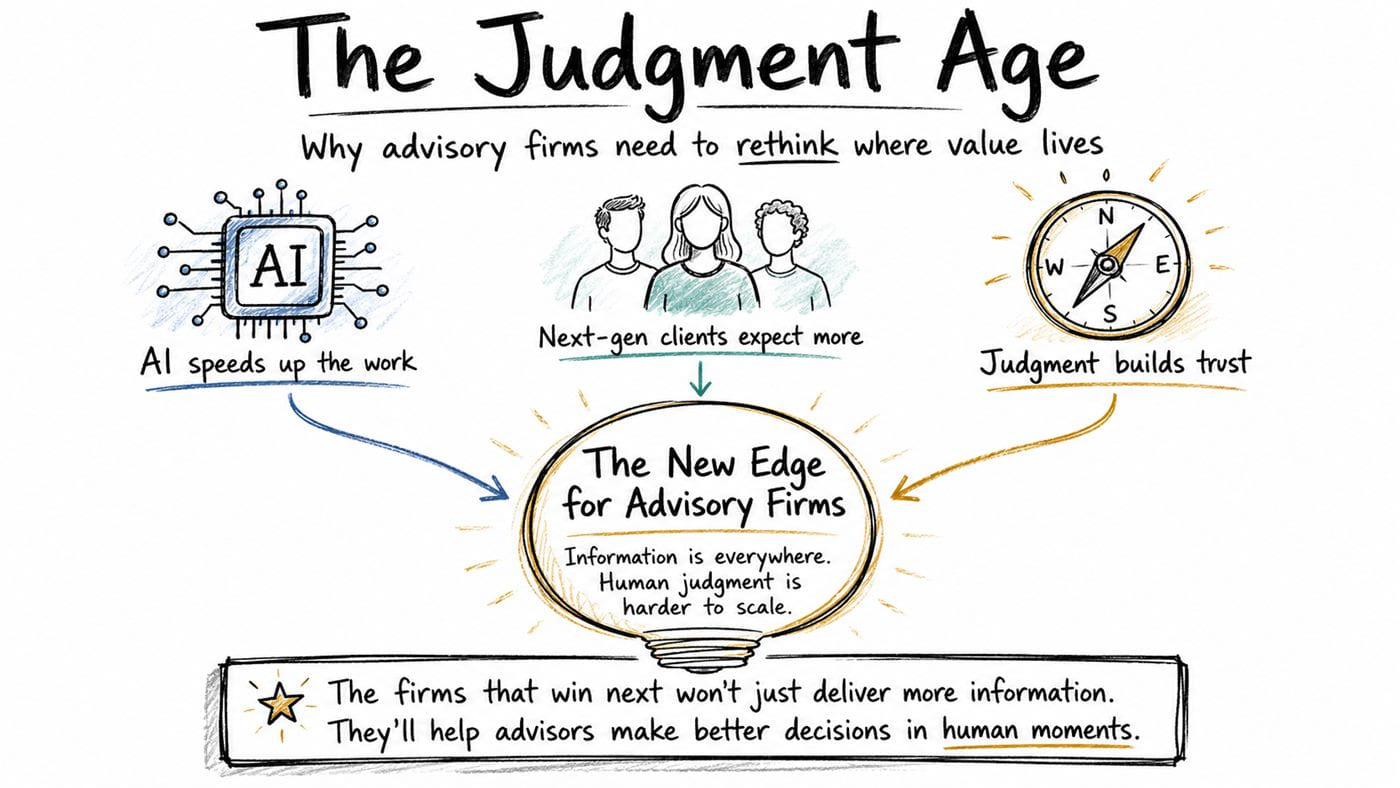
AI changes the work. Next-gen clients change the expectations. The Judgment Age changes the advisor’s role.
The advisor’s value is moving beyond having the information.
It is moving toward helping clients apply information wisely when life, money, family, identity, and uncertainty all meet in the same room.
That is the work advisory firms need to build for.
The future of advice won’t be won by information alone.
Digital access may earn attention.
Human judgment earns trust.
The question I’m sitting with
If AI changes the work of advice, what human capabilities do advisory firms need to build more intentionally?