On the human side of advice
Your Next-Gen Clients Are Already Coming to Meetings With an AI Plan
Information used to be the advisor's edge. Next-gen clients already have it. Here's what they're actually paying for.
What sparked this
This week I attended a talk by Brian Portnoy, founder of Shaping Wealth, called "Differentiating Yourself as a (Human) Advisor in the Age of AI" presented to Kitces.com. One idea landed and stayed with me.
Brian made a distinction between the advisor as mechanic and the advisor as guide.
The mechanic handles the technical work: investments, planning, insurance, tax strategy. The guide does something harder: helps human beings navigate uncertainty, manage change, process emotion, and make decisions that connect money to the life they are actually trying to build.
His point was direct. AI is reshaping the mechanic role fast. The guide role is where human advisors become irreplaceable.
I've been thinking about that distinction in the context of next-gen clients ever since. Because those clients are already arriving with the mechanic work done. And what they're looking for next is something no algorithm has figured out how to deliver.
A pattern worth paying attention to
Next-gen clients are arriving at advisor meetings already prepared. Not just with questions. With AI-generated analyses, scenario comparisons, allocation breakdowns, and in some cases, full draft financial plans they built themselves before the first conversation.
They are not coming in empty. They are coming in loaded.
And the advisors who handle this well are not the ones who ignore it, or try to establish authority over it. They are the ones who meet the client where they already are and take the conversation somewhere the AI could not go.
That distinction matters more than most firms realize.
What advice was actually built on
For most of the advisory industry's history, the value proposition had a clear foundation.
Advisors had access to things clients did not:
- Research tools and planning software
- Technical knowledge and licensing
- Investment options most clients couldn't access on their own
- Experience with complex situations clients had never faced before
That created a natural dependency. Clients needed advisors because advisors held the information, the tools, and the expertise.
That world has not disappeared. But it has changed significantly.
A next-gen client today can search, compare, watch, listen, ask AI, follow credible creators, join communities, and build a reasonably sophisticated financial opinion before they ever schedule a meeting. The information gap that once defined the advisor's advantage is narrowing fast.
Which raises the question every advisory firm should be sitting with: if information is no longer scarce, what is the advisor actually for?
What next-gen clients are actually asking
When firms talk about next-gen clients, the conversation usually goes to technology. Better portals, faster communication, more digital touchpoints.
That is not wrong. But it misses the deeper shift.
Next-gen clients are not asking for a more digital advisor. They are asking for a more relevant one.
They grew up with personalization everywhere. Their apps adapt to them. Their content feeds know their preferences. Their tools get smarter the more they use them. So when they sit across from an advisor who delivers a generic plan that could have gone to anyone, something quietly breaks.
They are thinking:
- Do you actually understand my situation, or just my assets?
- Can you explain why this recommendation fits my life specifically?
- Can you help me think through what I'm trading off, not just what you recommend?
- Do you see me as my own person, or as an extension of my parents?
These are not unreasonable expectations. They are what you would expect from any generation that has had access to information their entire lives and knows that information alone does not answer the real question.
The real question is always some version of: what should I actually do, and why does it fit the life I am trying to build?
What AI can and cannot do in that conversation
This is where the picture gets sharper.
A client who comes in with an AI-generated plan has done real work. The analysis may be solid. The scenarios may be well-constructed. The logic may be sound.
What the AI cannot do is what happens next.
It cannot notice that the client is asking about allocation but is actually worried about their marriage.
It cannot slow the conversation down when the client says they are ready to decide but their body language says otherwise.
It cannot help a business owner think through what identity looks like after the exit, not just what the tax structure looks like.
It cannot give a retiree permission to spend, when the numbers already support it but the fear does not.
It cannot tell a next-gen heir that it is okay to want something different from what their parents built.
As Brian framed it: AI can simulate cognitive empathy. It can understand a situation intellectually. What it cannot replicate is emotional empathy, the capacity to actually feel what the client is carrying in the room, and respond to it in a way that creates trust.
AI can generate answers. What it cannot do is determine which answer belongs in this moment, for this person, in this life.
That is the advisor's opportunity. And it is becoming more important, not less, precisely because AI is handling more of the technical work.
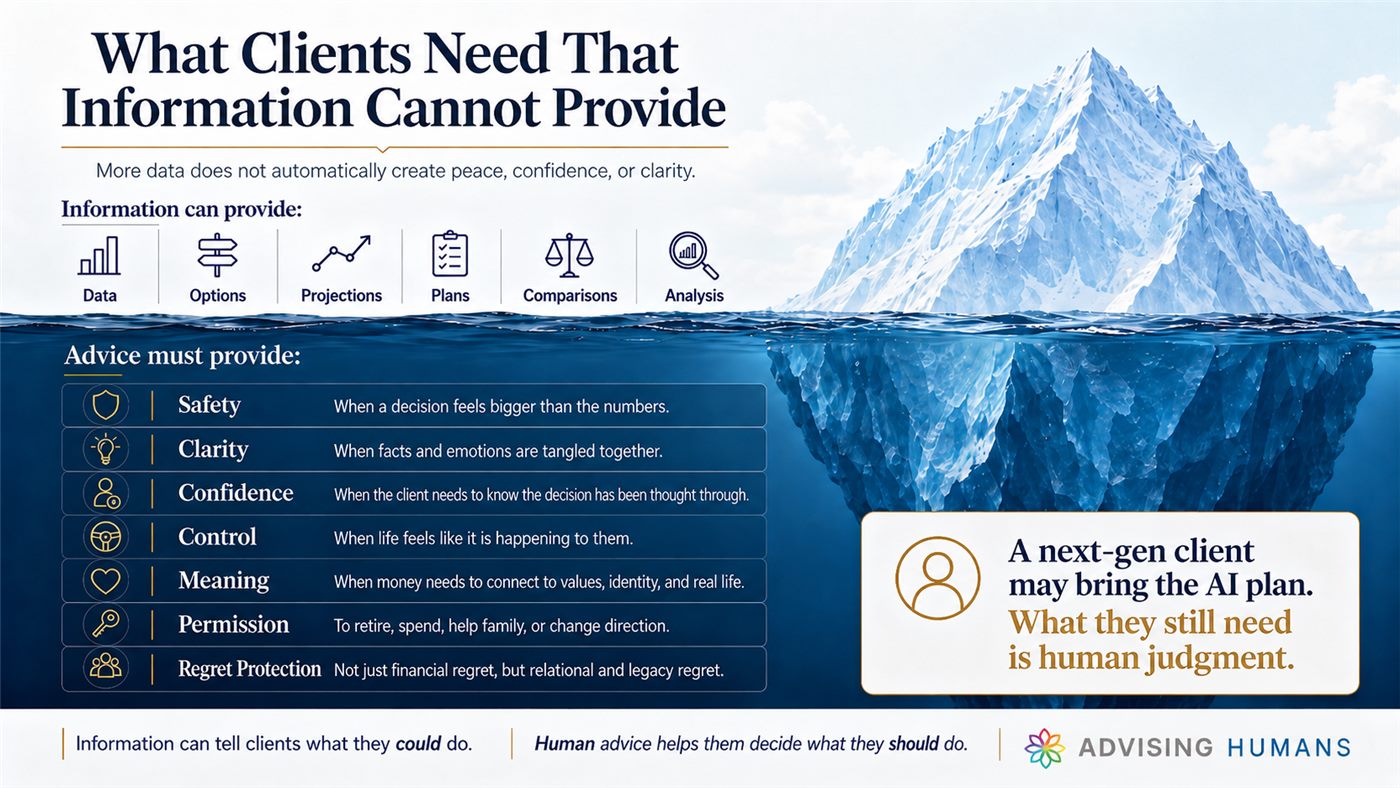
What clients need that information cannot provide
Here is what gets overlooked in most conversations about the future of advice.
Clients rarely struggle because they lack information. They struggle because they have too much of it, and cannot figure out what it means for them specifically.
They may have a plan, but not peace.
They may have options, but not confidence.
They may know what they could do, but still cannot decide what they should do.
The real jobs advice does are quieter and harder to systematize:
- Helping a client feel safe when a decision feels bigger than the numbers
- Creating clarity when facts and emotions are tangled together
- Giving confidence that a decision has been thought through from multiple angles
- Restoring a sense of control when life feels like it is happening to them
- Connecting money to meaning so the plan feels like it belongs to their actual values
- Giving permission to retire, to spend, to help their children, to change direction
- Protecting against regret not just financial regret, but relational and legacy regret
A next-gen client who comes in with an AI plan has handled the information layer themselves. What they have not solved is any of the above.
That is what they are hiring for.
The question firms need to answer
The next generation is not anti-advisor. The research is consistent on this. CFA Institute's 2026 next-gen investor study found that younger investors still trust human advisors most, even in an AI-shaped world. They want human judgment, personalized guidance, and a relationship that feels collaborative.
What they are against is advice that feels generic, transactional, or disconnected from the life they are actually living.
And that puts a specific pressure on firms.
The advisors who can do this well, who can sit with a client who already has an AI plan and take the conversation to a place the AI could not reach, often learned that ability over years. It lives in their instincts. It is not written down anywhere. It does not transfer automatically when they retire or when a client is handed to a newer advisor.
So the firm-level question is not just "do we have advisors who can do this?" It is: have we built a system that makes it possible for more advisors to deliver it, more consistently, across more client conversations?
That is the work most firms have not yet done.
The shift that matters most
EO Wilson once wrote: "We are drowning in information but starved for wisdom."
That line was written long before AI. But it describes the next-gen client experience exactly.
They do not need you to explain the options. They need you to help them figure out which option they can actually live with.
The firms that earn those relationships will not be the ones with the best technology or the most comprehensive planning process. They will be the ones where clients finish a meeting feeling something that is hard to manufacture and impossible to automate:
"They get me. I can move forward."
The question I keep sitting with: as AI takes on more of the mechanic work in advice, how intentionally are you building the guide capabilities across your team? Not in training decks. In actual client conversations.