On the industry
McKinsey Identified the Advisor Shortage. They Did Not Identify What Happens to the Clients Inside It.
For two years, I have been in rooms full of wealth management leaders talking about the same problem.
At conferences. In conversations with firm leaders directly.
The advisor shortage.
Everyone knows the number. McKinsey put it at 100,000 advisors short by 2034. Firms are responding the way you would expect. Recruiting harder. Building teams. Creating pathways for career changers. Investing in productivity tools.
Those are the right answers.
But after two years of those conversations, I keep waiting for someone to ask the question that never comes up.
What happens to the relationships while all of that movement is happening?
The numbers are real, and they matter
Before anything else: McKinsey is right.
The shortage is not hypothetical. The industry added only 8,000 net new advisors over the prior decade and needs between 30,000 and 80,000 more this decade to keep pace with demand. Nearly 80% of affluent investors say they would pay a meaningful premium for human advice over automated alternatives. The share of wealthy clients seeking more comprehensive, life-centered advice nearly doubled between 2018 and 2023.
The demand is there. The supply is not growing fast enough to meet it.
And the talent market is already under pressure. Roughly 27,000 advisors switch firms or go independent every year. McKinsey calls the competition for that pool "zero-sum." Recruiting packages are rising. Firms are competing for a recycled group of experienced advisors rather than growing the overall base.
The structural response the report recommends makes sense: more campus recruiting, clearer pathways for career changers, expanded teaming models, AI-enabled productivity gains. Teaming in particular is well-supported by the data. Advisors on teams manage practices roughly 20% larger than solo practitioners.
The industry needs all of this. But solving the supply problem does not automatically solve what happens to the relationships inside it.
The other problem
Here is what I keep noticing that nobody is building for.
Every solution being proposed creates movement inside firms. Career changers are brought in and handed relationships they have not earned yet. Junior advisors step up to fill seats left by retiring seniors. Teams expand, books get divided, clients get reassigned. Firms grow through acquisition and discover that "we have your accounts" is not the same as "we know your family."
That movement is not neutral for clients.
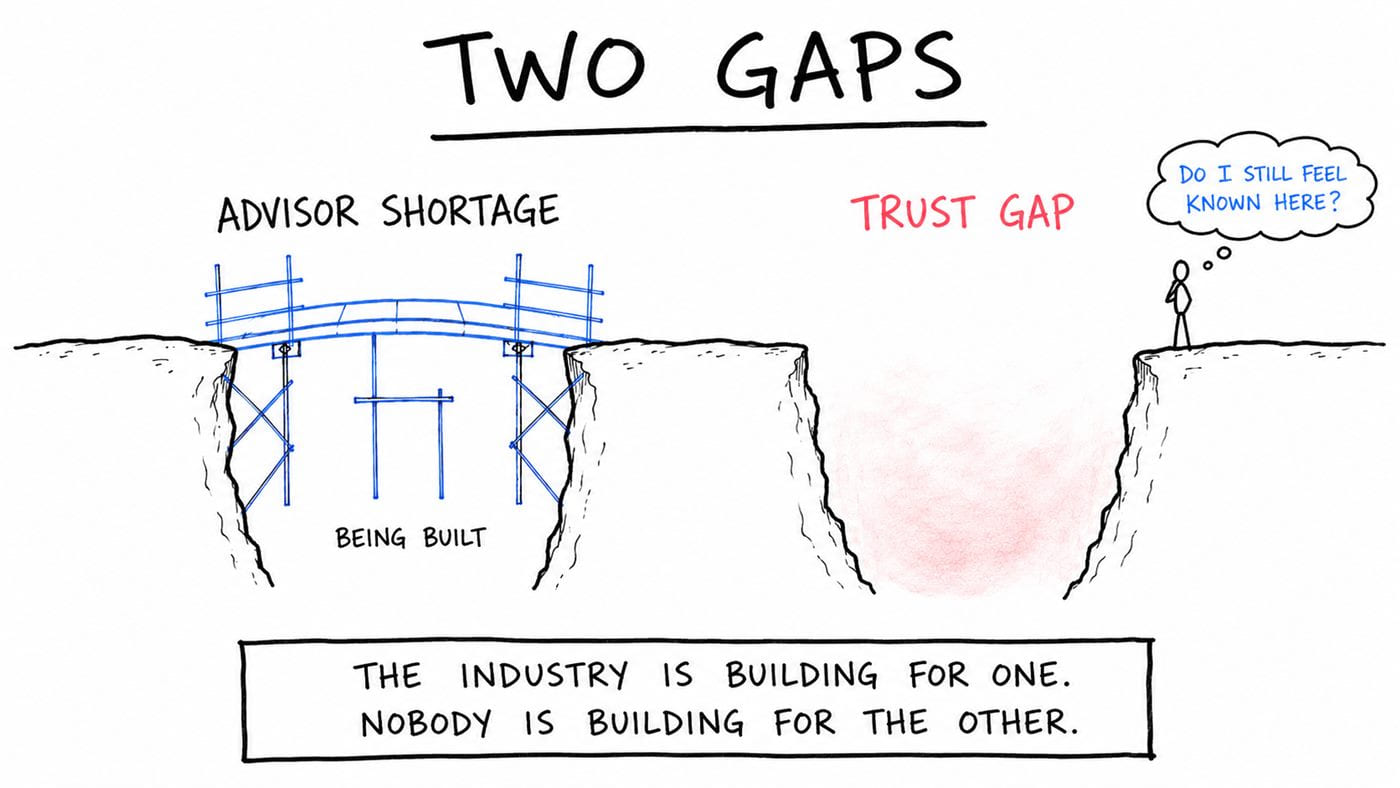
Each time the person serving a client changes, something happens to the relationship layer that is almost impossible to see from the inside. Clients who had built years of trust with one advisor now face a different question: do I still feel known here?
The industry is building solutions for the supply problem. Very few firms are building solutions for the continuity problem that lives inside the supply solution.
Those are not the same problem.
Teams solve the capacity problem. They create a new one.
Teaming is the right answer to the capacity problem. Most firms have not yet built the thing teaming requires.
When a firm moves from solo practitioners to team-based models, it gains real capacity. Bigger books. Better coverage. More resilience when one advisor is unavailable. The McKinsey data supports this, and so does the experience of most enterprise firms.
But teaming assumes something that very few firms have actually built: a system for transferring what a senior advisor knows about a client to the people who will serve that client next.
Most of what an experienced advisor knows about a long-standing client does not live in a CRM. It lives in memory. The context of a difficult year. The conversation where the client admitted their spouse handles most of the decisions. The investment history that informed a choice that looked strange on paper but made complete sense given the family situation.
When a senior advisor steps back, retires, or reduces their role, that context does not automatically follow the account. A junior advisor or career changer may step into that relationship with full operational access and almost no relational depth.
The client experiences that gap immediately, even if the firm believes the transition was managed well.
Inside the firm, it looks like a smooth transfer.
Inside the client's experience, it can feel like starting over.
What clients are not saying out loud
When a client has worked with the same advisor for ten years, they have stopped re-explaining themselves. The advisor already knows. That is not a small thing.
When that relationship changes, through retirement, reassignment, firm growth, or M&A, the client faces a question the firm may not realize it is asking them to answer.
They may not ask it out loud. They may say "that's fine" while privately reassessing. They may stay polite through the first meeting, the second meeting, the third. But something shifts internally. They share a little less. They delay the next review. They mention they had a conversation with another advisor "just to get a second opinion."
The account may still be there.
The confidence may already be drifting.
With 27,000 advisor transitions per year, and that number expected to rise as the retirement wave accelerates, this is not an edge case. It is a structural feature of the market that firms are building toward. Every firm that scales rapidly through new hires, career changers, and expanded teams is creating more of these trust moments, not fewer.
The thing most firms have not built yet
The firms getting this right are not doing anything exotic. They have just built something most firms have not. A way to make sure what a senior advisor knows about a client does not disappear when that advisor leaves the room.
A process answers who is assigned, what was updated, and what is scheduled.
A trust-transfer system answers whether the client still feels known.
Most firms have the first. Very few have built the second.
That gap does not close by hiring faster. It closes when firms treat client context as infrastructure, not as something that lives in one person's memory and walks out when they do.
The shortage conversation is the right conversation. It is just not the whole one.
The shortage is real. The solutions being built are the right ones.
The other gap is quieter. It lives inside every relationship that gets handed to someone new before that someone has earned the right to hold it.
Somewhere in your firm right now, a client is quietly deciding whether to stay. You probably do not know which one.
If you are past the point of recognizing the problem and ready to think about what to build, I'd be glad to be in that conversation with you.