A note · on advisor change
Feel More Personal
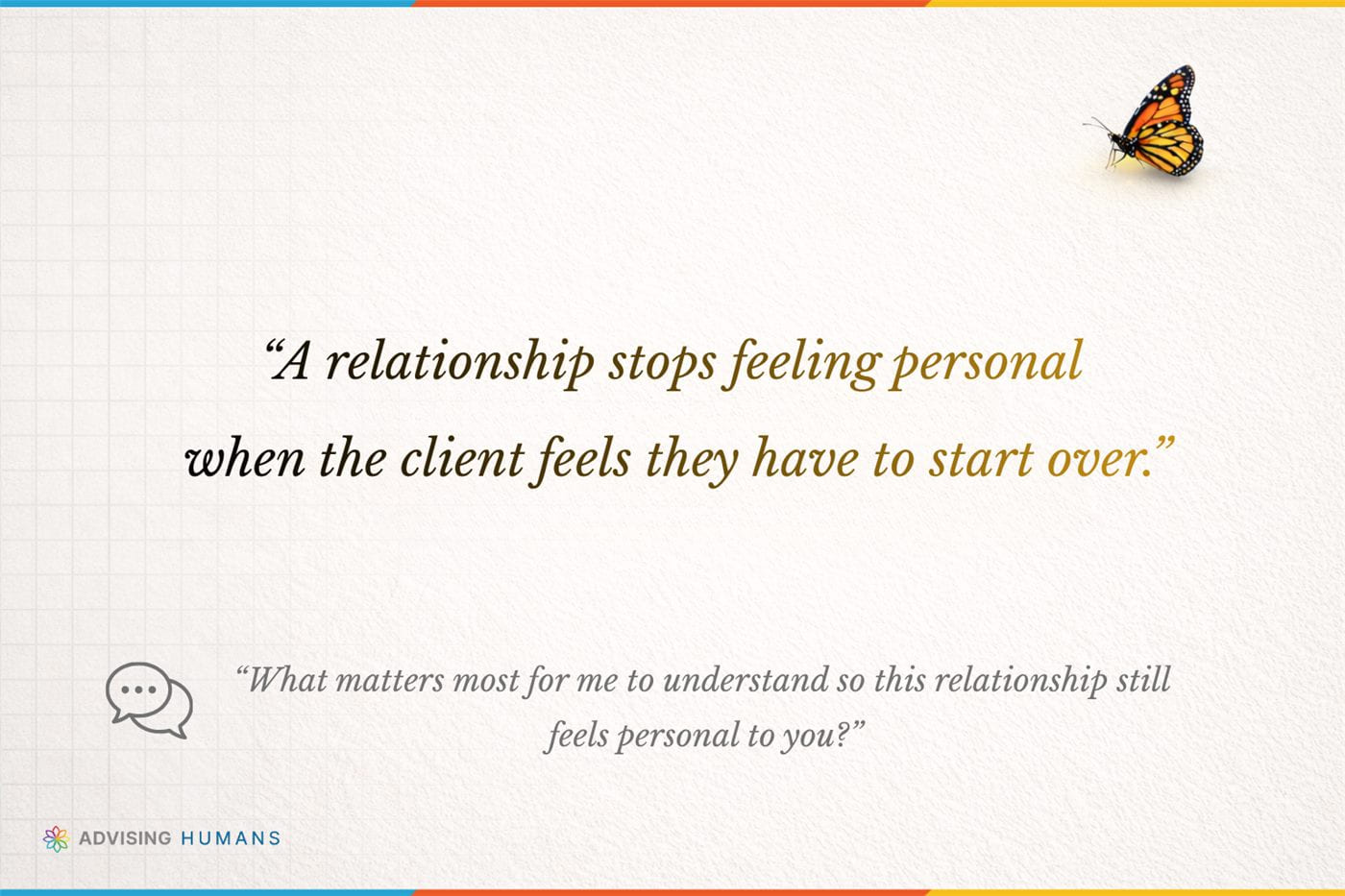
What does “personal service” actually mean to your clients, and what happens when they stop feeling it?
Many advisors think personal service means responsiveness, warmth, check-ins, and remembering important details.
Those things matter.
But during an advisor transition, clients may experience “personal” very differently.
When an advisor retires, moves firms, changes teams, or transitions a client to someone new, the client may not be asking only:
- Who will I work with now?
- Will anything change?
- Does the new advisor know our situation?
- Will my spouse feel comfortable?
- Are we going to have to start over?
Underneath those practical questions is often something deeper:
Will I still feel known here? Will this still feel personal?
That is where many advisors and firms can misread the moment.
From the advisor’s point of view, personal may mean:
- remembering birthdays
- checking in regularly
- being warm and friendly
- asking about family
- making time for the relationship
But through the client’s eyes, personal often means something else.
It means:
- I don’t have to re-teach you who we are
- you understand what matters to me
- you understand my family dynamics
- my spouse feels included and comfortable
- you understand how I make decisions
- you remember what is sensitive, important, or hard
- the relationship feels carried forward, not reset
In other words:
Personal is not just warmth. Personal is continuity, context, and care that the client can actually feel.
That matters even more during advisor retirement, succession, internal reassignment, or M&A-related transitions.
Because when the relationship changes, clients are not only evaluating competence.
They are also evaluating whether the human connection still feels intact.
One of the most useful questions an advisor can ask in that moment is:
“What matters most for me to understand so this relationship still feels personal to you?”
That question does something important.
It shifts the goal from simply taking over the relationship to carrying it forward well.
And that is the difference between a transition that feels procedural and one that feels personal.
This also matters for next-generation relationships.
Younger family members often expect advice to feel more personal, relevant, and tailored to their lives. Real personalization is not just a transition skill. It is part of building the future of the relationship.
If your firm is navigating advisor retirement, succession, acquisitions, or client reassignment, I’d be curious:
What do you think makes a relationship actually feel personal from the client’s side?